Manufacturing Capabilities
Capability here means what the floor can hold, not what a brochure lists: 220 machines on 5,000 m² at Shajing, 100 of them 5-axis, 50 CNC 46-series lathes and 70 Tsugami sliding-head lathes. Standard tolerance ±0.005 mm, MOQ 1 piece, prototypes 3–7 days, batch production 7–15 days. ISO 9001:2015 and ISO 14001:2015, every lot measured on a CMM.
CHX Precision Metal operates 220 CNC machines in our 5,000㎡ facility in Shenzhen Bao'an Shajing. Our equipment line covers 5-axis machining, precision turning, Swiss-type lathes, and in-house quality inspection. The factory covers 5,000 m2 and produces up to 5 million precision parts per month.
Equipment Lineup
| Category | Brand/Model | Quantity | Capability |
|---|---|---|---|
| 5-Axis Machining Center | 5-axis simultaneous, 30 of them 3+2 | 100 | ±0.005 mm |
| CNC Lathe | 46 series, bar stock only | 50 | Ø20–46 mm bar on 50 46-series lathes (Ø46–300 mm by review), ±0.005 mm |
| Swiss-Type Lathe | Tsugami sliding-head | 70 | Ø1–20 mm, complex small parts |
| Total | 220 machines on 5,000 m² | 5 million pieces per month | |
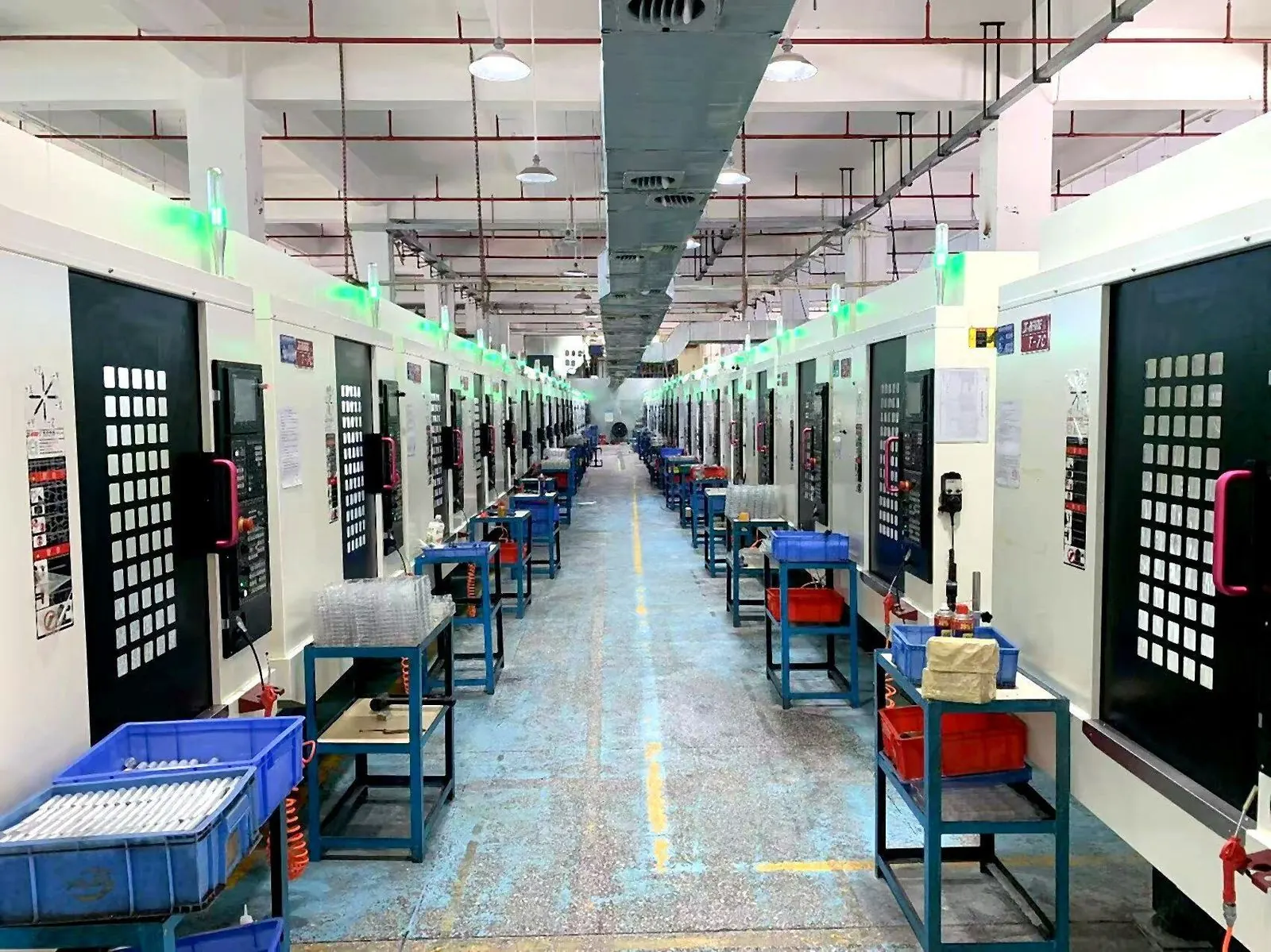
Matching the Part to the Machine
The equipment list only matters if it maps to a part envelope. Below is how a drawing is routed on our floor: the envelope and batch size decide the line, and the line decides the setup count, which is what actually drives cost.
| Part envelope | Typical batch | Line used | Why that line |
|---|---|---|---|
| Ø1–20 mm, turned from bar | 1,000–500,000 | Tsugami sliding-head (70 units) | Guide bushing supports the work within 1 mm of the cut, so thin walls hold in one pass and secondary turning is usually unnecessary |
| Ø20–46 mm, turned from bar | 500–200,000 | 46-series CNC lathe (50 units) | Bar-fed, no blank preparation, one chucking per side |
| Ø46–300 mm, chucked | 50–20,000 | CNC lathe, chuck work (by review) | Above bar capacity, quoted after a review of blank cost and swing |
| Prismatic, up to 3 faces | 100–50,000 | 3-axis VMC | Lowest cost per part when no compound angle is involved |
| Prismatic, 5 faces or compound angles | 50–20,000 | 3+2 machining centre (30 of the 100 units) | Positioned indexing keeps one setup where a 3-axis machine needs three |
| Free-form surfaces, walls under 1 mm | 20–5,000 | Simultaneous 5-axis (100 units in total) | A continuous tool vector avoids the witness marks and chatter that step-over leaves on thin sections |
Two routing rules follow from this. A part that fits a sliding-head machine is almost never cheaper on a lathe with a chuck, because the bar stock and the guide bushing remove both the blank and the second operation. A part that needs a compound angle is almost never cheaper on 3-axis with multiple fixtures, because fixture error stacks across setups and shows up as position tolerance on the finished part.
One Part Family, Three Lines
A 316L VCR fitting set shows how that routing logic behaves on a real order, because a set is not one part. It is a short gland, a long gland, a nut, a gasket, and where the run turns, an elbow or a tee. Each of those leaves the floor as its own process stream, and the set only comes back together at cleaning, inspection and packing.
| Component | Line used | Why it lands there |
|---|---|---|
| Short gland | Gang-tool lathe | Short and rigid, one setup, and the batch size justifies a fixed tool layout rather than repeated program changes |
| Long gland, nut, gasket | CNC turning centre | Thread and seal face are cut in the same chucking, so the two features cannot drift apart between operations |
| Elbow, tee | 3-axis VMC, 3+2 where port faces sit off-axis | The bore breaks into the thread at an angle a single-point tool cannot reach, so it is milled and deburred at the intersection |
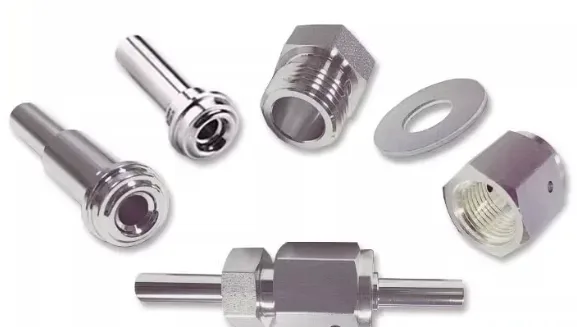
None of this set goes on the sliding-head machines. A VCR component is mostly thread and seal face, and a guide bushing buys nothing on that geometry; the gang-tool lathe and the turning centres are where it belongs, and the elbows are a milling job from the first operation.
Two bore sizes are in production, 1/4" and 1/2", all 316L including the nut and the gasket. Electropolishing is carried out by a qualified subcontract partner rather than in house, so that step is quoted inside the lead time. The family is supplied to equipment builders and gas-line integrators on long-term programmes from 10,000 sets, and a single component from a set can be ordered on the same volume basis. It is not listed on B2B marketplaces, because the price follows the drawing and the programme rather than a cart.
Quality Assurance
Every part is inspected on a CMM. Our quality management system is certified to ISO 9001:2015, with ISO 14001 environmental certification. Measurement reports, PPAP documentation and first-article samples are available on request. Production capacity reaches 5,000,000 parts per month, supporting long-term contracts at fixed pricing.
What Gets Measured, and How Often
Inspection is scheduled by feature criticality, not applied uniformly. A cosmetic bracket and a valve body do not need the same sampling, and charging them the same inspection cost would be wrong in both directions.
| Check | Frequency | Equipment | Recorded as |
|---|---|---|---|
| First article, full dimensional | Every new part number and every revision | CMM | Dimensional report with the shipment |
| Critical dimensions in process | First piece after each setup change | CMM or height gauge | Setup sheet sign-off |
| In-process sampling, running lot | Per drawing or per agreed AQL | CMM, callipers, pin gauges | Lot record, retained |
| Surface roughness | On parts with a Ra callout | Roughness tester | Value per drawing zone |
| Thread and tapped holes | 100% on critical threads, sampling otherwise | Thread gauges | Go / no-go result |
| Visual and burr | 100% | Bench inspection | Defect code, if any |
| Material and finish traceability | Every lot | Mill certs, finish pass-off | EN 10204 3.1 on request; finish thickness report |
Every shipment carries a dimensional report for the features on the drawing. If a feature is not on the drawing, we will not invent a tolerance for it — send the requirement and it becomes a controlled characteristic.
Lead Times & Delivery
Prototypes: 3-7 working days. Series production: 7-15 days, up to 20 days including surface treatments. Worldwide shipping via DHL/FedEx with anti-corrosion packaging and dedicated trays for precision components. Full lot traceability from raw material to shipment.
How the 3–7 Day Prototype Window Is Built
The prototype lead time is a schedule, not a promise. It assumes the drawing is complete on day zero: material, tolerance, surface finish and quantity all stated. A drawing that arrives without those is quoted the same day but starts the clock later.
| Day | What happens | What can delay it |
|---|---|---|
| 0–1 | Drawing review. We flag features that cannot be held at the stated tolerance, or that need a different process. | Missing material spec, undefined datum scheme, tolerance tighter than the process can hold |
| 1–2 | CAM programming, tooling set-up, material cut to length. | Material not in stock locally — 7075 and titanium plate are the usual culprits |
| 2–4 | First-piece machining on the routed line. | Fixture design for a thin or awkward part |
| 4–5 | CMM inspection against the drawing, first-article report drafted. | A dimension out of tolerance needs a re-cut, which restarts the machining step |
| 5–7 | Surface finish if specified, then packing. | Anodising colour matching and hard anodising add 3–7 days on their own, outside this window |
Batch production runs 7–15 days after first-article approval, and the clock for that is the approval date, not the order date. Shipping is EXW Shenzhen — we are happy to recommend freight forwarders, but the freight contract is yours.
Why CHX Precision Metal
CHX Precision Metal operates a 220-machine production facility in Bao'an, Shenzhen: 100 Taikan T600 machining centres (30 of them 3+2 five-axis), 50 CNC 46-series lathes and 70 Swiss-type automatic lathes. We work directly without intermediaries — from DFM review to scheduled Kanban deliveries. RFQ responses within 24 hours, including manufacturability feedback and cost optimization.
Frequently Asked Questions
What is your MOQ?
We accept orders from 1 part for prototypes; for series production, lots from 100 pieces are most economical, with annual fixed pricing for high volumes.
Can you work from our drawings?
Yes — we accept STEP, IGES, DWG and PDF. Our engineers review manufacturability and respond to your RFQ within 24 hours.
What are your lead times and how do you ship?
Prototypes: 3-7 working days. Series production: 7-15 days, up to 20 days including surface treatments. Worldwide shipping via DHL/FedEx with anti-corrosion packaging and dedicated trays for precision components. Full lot traceability from raw material to shipment.
Send your drawing, get a price in 24 hours
Name, email and what you need. Attach a drawing if you have one — STEP, PDF, DXF or a photo of the print. We reply with unit price, MOQ and lead time, usually within one working day.
Prefer email? Send drawings to mc@chxmetal.com.