Comparing CNC Machining Suppliers in China: A 12-Point Checklist
Comparing CNC machining suppliers in China comes down to four measurable things: the tolerance actually held on production runs, the machine list behind the quote, documented inspection with measured values, and landed cost to your door. Ask for ±0.005 mm verified by CMM, a named spindle count, FAI reports per batch, and a DDP figure. Everything else is sales language.
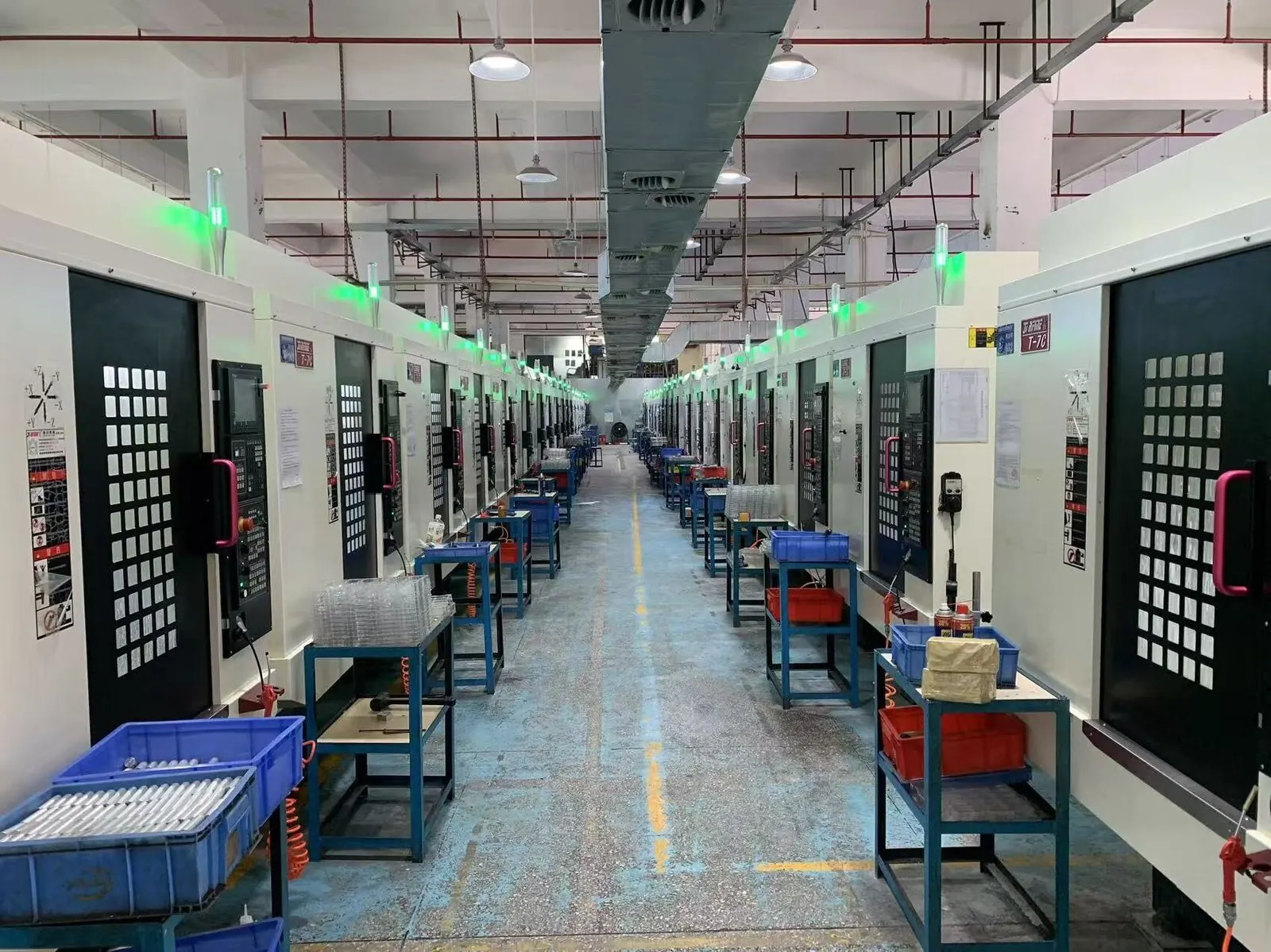
Most supplier comparisons fail for the same reason: they compare adjectives. "High precision", "rich experience", "fast delivery" appear on every website in the industry and distinguish nothing. What distinguishes suppliers is whether they can answer a numeric question with a number — how many spindles ran aluminium last month, what tolerance held across the last 10,000 pieces, what the DDP cost was on the previous shipment.
This page is the checklist we would use ourselves if we were buying. Every criterion is something you can request in writing before placing an order, and every benchmark is a figure you can hold a supplier to.
1. Why a numeric comparison beats a supplier list
Almost every "top 10 CNC suppliers in China" page circulating today is written by a supplier that places itself first. That structure is not useless — it tells you who is investing in being found — but it is not a comparison. When you read one, check whether the ranking entity appears in its own list, and whether the other entries carry measured values or just descriptions.
A numeric comparison inverts the direction: instead of asking who is good, you ask what a good answer looks like, then measure each candidate against it. That works even when the candidate is a company you have never heard of, and it works when the candidate is us.
2. The 12 checks that separate capable shops from resellers
Each check below can be answered in one email. A supplier who answers eight or more with specifics is worth a sample order. Fewer than six, and you are probably talking to an intermediary.
| Check | What to ask | Benchmark to accept | Why it matters |
|---|---|---|---|
| Tolerance on production | What tolerance held across the last 10,000 pcs? | ±0.005 mm on critical features, CMM-verified | Prototype tolerance does not predict batch tolerance |
| Machine list | How many spindles, of which type? | Named count, with the share that ran your material last month | Spindle count is checkable; 'advanced equipment' is not |
| Material certificates | EN 10204 3.1 for this heat number? | Yes, per batch, traceable to the heat | Explains a failure before you machine 5,000 more |
| Inspection documents | FAI with measured values? | Yes, values not pass/fail stamps | A stamp does not tell you how close to limit you are |
| Sub-spindle | Can the back side finish in one setup? | Yes, or an explicit second-op plan | Re-chucking is where tolerance stack accumulates |
| Guide bushing | Swiss-type for long thin parts? | Yes, for Ø2–20 mm work | Chuck lathes deflect on slender parts |
| Thin-wall plan | What is the plan below 1.5 mm wall? | Fixture design, stress relief, post-release measurement | Tells you whether the answer is engineered or guessed |
| Finish and growth | Is the tolerance before or after finishing? | Stated explicitly, with masking plan | Anodizing moves dimensions by ~0.025 mm per surface at 50 µm |
| Landed cost | DDP to my address? | DDP figure with HS code | FOB prices are not comparable across freight modes |
| Capacity | Monthly output for this part family? | A number, with current load | Capacity claims without load data are meaningless |
| Change management | How is an ECO handled mid-batch? | Written revision control, first article per revision | Most escapes come from an unrecorded revision |
| Communication | Who answers technical questions? | A named engineer, response time in hours | Sales-only contact channels lose the technical question |
3. Four supplier types in China and what each is actually good at
Type matters more than size. A 40-person shop dedicated to aluminium will outperform a 600-person general factory on an aluminium housing programme, and lose badly on a mixed-material assembly. Identify the type before comparing prices, because prices are only comparable within a type.
| Type | Typical size | Genuinely good at | Where it fails | Typical use |
|---|---|---|---|---|
| Small quick-turn shop | 10–40 staff | Prototypes, single-piece, fast iteration, low setup overhead | Volume consistency; inspection depth | Design validation |
| Mid-size specialist | 80–300 staff | One material family or one process, repeatable parameters, dedicated fixtures | Mixed-material assemblies; multi-process coordination | Batch and volume parts in one material |
| Large general factory | 500+ staff | Multi-process, multi-material, big capex, formal systems | Small batches lose priority; aluminium may be a side line | Complex assemblies at volume |
| Trading company / broker | 5–30 staff | Fast quoting, wide sourcing, English communication | No spindle, no CMM, no control over the process | Sourcing a process nobody else offers |
One practical consequence: when you compare quotes across types, the lowest quote is almost always the type least suited to your part. A broker can quote low because it carries no fixed cost; a large general factory can quote low on a simple part because it amortises setup across many jobs. Neither number predicts what happens when your drawing has a ±0.005 mm callout and a 0.8 mm wall.
4. Benchmarks specific to aluminium batch work
Aluminium is the material most Chinese shops claim and the one where claims diverge most from capability. Four figures separate the two.
Spindle share. Ask what percentage of machining centres ran aluminium in the last month. A shop set up for aluminium runs aluminium fixtures, aluminium-specific tooling with polished flutes and high helix angles, and cutting parameters already dialled in. We run 100 machining centres, 30 of them 3+2 positioned five-axis machines dedicated to aluminium, which is why a housing programme starts at a known parameter set rather than a trial.
Wall thickness discipline. Walls below 1.5 mm need fixture design before programming, a stress-relief pass between roughing and finishing, and measurement after the part is released from the fixture. If a supplier quotes a 0.8 mm wall without asking how you want it measured, the number is aspirational.
Anodizing growth. Anodizing moves dimensions. A Type III layer of 50 µm grows roughly half outward and half into the base metal, adding about 0.025 mm per surface. Ask whether print dimensions apply before or after finishing — suppliers who have not thought about this will pass the error to you.
Tolerance layering. Put ±0.005 mm only on features that mate or seal, and let general dimensions run to ISO 2768-m. A drawing that stamps ±0.005 mm on every dimension multiplies inspection time without adding function, and it is the single most common reason a reasonable part becomes expensive.
5. Benchmarks specific to CNC turning in aluminium, stainless and brass
Turning is a different capability from milling and should be evaluated separately. Three questions do most of the work.
Is there a guide bushing? Long, thin parts — Ø2–20 mm pins, connectors, fittings — deflect without one. Swiss-type sliding-headstock machines support the work at the cut, which is why they hold tolerance on parts that a chuck lathe cannot. We run 70 Tsugami Swiss-type lathes alongside 50 CNC lathes, and the split matters: chuck work goes to the lathes, long thin work goes to the Swiss machines.
Is there a sub-spindle? If the back side needs a second operation, a sub-spindle finishes it in the same setup and removes a re-chuck error. Ask directly; it changes both tolerance stack and price.
How is tool life managed across a long run? On a 50,000-piece run the question is not whether the first piece is good but whether piece 40,000 is. Ask for the tool-change interval, the in-process gauging method and whether SPC trend data ships with the batch.
6. What a complete quotation should contain
A quote that gives one number and a lead time is not a quote, it is an opening position. The table below lists what a quote should carry for a drawing with a tolerance callout.
| Quote item | A complete answer looks like | What is usually missing |
|---|---|---|
| Unit price at your batch size | Price at this quantity, plus tiers for 2× and 5× | Tiers — so you cannot plan a scale-up |
| Setup and tooling | Separate line, one-off or amortised | Hidden inside the unit price, then charged again on a re-run |
| Material | Grade, temper, certificate type (EN 10204 3.1) | Only 'aluminium' with no temper or heat number |
| Finish | Process, thickness, masking, colour reference | Thickness and masking, which change dimensions |
| Inspection | Which features, which instrument, which report format | A flat 'full QC inspection' line with no method |
| Lead time | Prototype and production stated separately | One number that covers both |
| Incoterm | FOB / CIF / DDP with the named place | FOB only, leaving freight and duty to you |
| Payment terms | Deposit and balance, with the trigger event | A percentage with no trigger defined |
| Revision basis | The drawing revision the price applies to | No revision reference, so an ECO reopens everything |
7. How to run a three-supplier comparison in two weeks
Days 1–2. Send the identical RFQ package to all three: 2D PDF, 3D STEP, material, finish, batch size, target date, and the four questions from section 2. Identical input is what makes the outputs comparable.
Days 3–7. Collect quotes. Score each on the 12 checks rather than on price. Reject any quote that omits the inspection plan or the material certificate.
Days 8–10. Send one DFM question the drawing does not answer — a datums question, a finish-mask question, a tolerance-stack question. The quality of that answer predicts the quality of the whole relationship better than the price does.
Days 11–14. Order one sample batch from the top two. Compare measured values, not certificates of conformity. Then place volume with the one whose numbers you trust.
8. Where CHX Metal sits on this table
We publish our own figures so you can score us the same way you score anyone else. These are capability numbers, not marketing claims, and each one is verifiable on a supplier audit or a sample order.
| Check | Our figure | How to verify |
|---|---|---|
| Machines in-house | 220 total: 100 machining centres, 50 CNC lathes, 70 Tsugami Swiss-type lathes | Supplier audit; machine plates and serial numbers |
| Aluminium-dedicated spindles | 30 of the 100 machining centres are 3+2, run on aluminium daily | Ask for the last month's job list |
| Tolerance | ±0.005 mm on critical features, ±0.005 mm or better on request; general to ISO 2768-m | FAI and CMM reports on your first article |
| Inspection equipment | 8 in-house instruments including a Leyden CMM | Audit; request a CMM report with the batch |
| Monthly capacity | Up to 5,000,000 pcs | Current load discussion on the quote |
| Turning split | 50 CNC lathes for chuck work, 70 Swiss-type for Ø2–20 mm long thin parts | Ask which line your part runs on |
| Prototype lead time | 3–7 days | Written into the quote |
| Production lead time | 7–15 days, plus 3–7 days for surface treatment | Written into the quote |
| Minimum order | 1 piece, with tiered pricing at volume | Ask for the tier table |
| Certification | ISO 9001:2015 (NOA198428, valid to 2028-06-30) and ISO 14001:2015 (NOA2100184, valid to 2027-01-04) | Certificate numbers, issuer NOA, IAF MLA signatory |
| Not claimed | IATF 16949 and ISO 13485 are being implemented, not held | Ask us directly — we will say so |
| Finishing | Anodizing, zinc and nickel plating, passivation, black oxide, powder coating, laser marking | Ask which are in-house for your part; specialty finishes are reviewed case by case |
Frequently asked questions
How do I compare CNC machining suppliers in China without visiting them?
Ask for four documents on the same RFQ: a first-article inspection report with measured values, the machine list behind the quote, the material certificate for the actual batch, and a DDP price to your address. A supplier that cannot produce all four for one job is probably brokering it.
What tolerance should I expect on production runs, not just prototypes?
Ask separately. Prototype tolerance is easy; production capability is what you live with. On aluminium batch work we hold ±0.005 mm on critical features with CMM verification, and general dimensions to ISO 2768-m so inspection effort goes where it changes function.
Does a low unit price mean a low landed cost?
Not usually. Compare DDP, not FOB. Freight mode, HS classification, packaging and the cost of re-inspection after a rejected batch all sit outside the unit price. Two quotes 15% apart on unit price can invert once landed cost is calculated.
How many machines should a supplier have for a 10,000-piece aluminium batch?
Machine count matters less than whether the machines are dedicated to your material family. A shop running aluminium daily holds aluminium fixtures, tooling and cutting parameters; a general shop resets for every job. Ask what share of their spindles ran aluminium last month.
What is the difference between a trading company and a factory in China?
A trading company quotes fast and can source many processes, but cannot show you the spindle, the fixture or the CMM. A factory can. For anything with a tolerance callout, a dimensional report or a material certificate, work with the entity that actually cuts the metal.
How do I verify ISO 9001 is real and not a stock logo?
Ask for the certificate number, the issuing body and the validity date, then check the body is an IAF Multilateral Recognition Arrangement signatory. Our ISO 9001:2015 is NOA198428, valid to 2028-06-30, issued by NOA.
Should I split an order between two suppliers?
Split only after both have passed a first article. Splitting a first batch doubles the inspection and the communication load, and hides which supplier caused a deviation. Run the first article with one, then dual-source the repeat volume.
How long should a fair comparison take?
Two weeks is enough for three suppliers: five working days for quotes, three for DFM questions, then one sample batch each. If a supplier cannot return a quote in five working days for a defined drawing, the same delay will appear on every change order.
Compare us against your shortlist
Send the drawing and the batch size — the reply includes DFM notes, a DDP figure and the inspection plan.
Email: mc@chxmetal.com | WhatsApp: +86-181-3885-0989
Shenzhen Changhexin Precision Hardware Co., Ltd. (CHX Metal) · Shajing Street, Bao'an District, Shenzhen, Guangdong, China · ISO 9001:2015 (NOA198428) · ISO 14001:2015 (NOA2100184)
This page describes how to evaluate suppliers. It does not rank or name other companies; the figures shown are our own and can be verified on request.
Related: CNC turning in aluminum, stainless and brass · CNC machining supplier for US buyers · CNC batch production · Tolerance capability