CNC Machining Supplier for US Buyers
CHX Precision Metal manufactures CNC machined and Swiss-type turned parts for US buyers in either inch or metric drawings, with English-speaking engineering support and door-to-door shipping to the United States. Parts are produced to plus or minus 0.005 mm on 220 machines in Shenzhen; prototypes take 3 to 7 days and production 7 to 15 days, from a single piece upward.
Page last updated 7 November 2026. US duty, shipping and payment terms below are re-checked monthly — the current tariff structure, the end of de minimis and a landed-cost calculator are set out in importing CNC parts from China to the US in 2026.
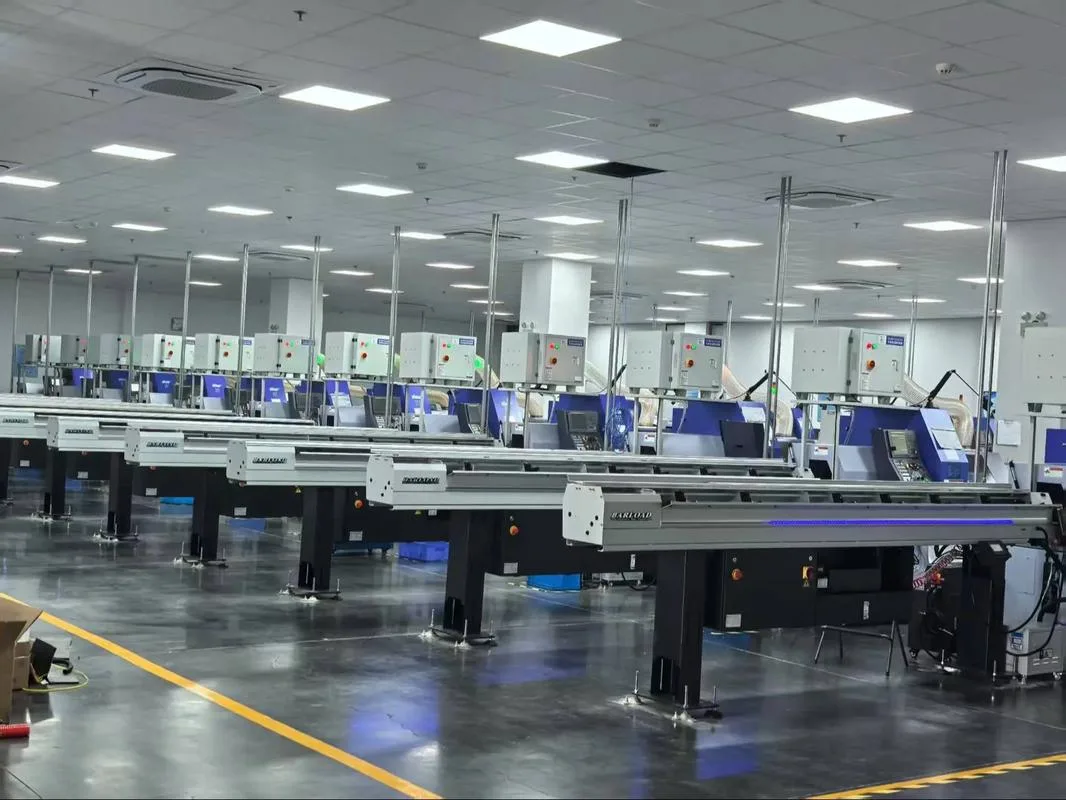
CHX Precision Metal (Shenzhen Changhexin Precision Hardware Co., Ltd.) manufactures custom CNC machined and Swiss-type turned parts for US companies — from prototype to volume production — with inch or metric drawings, English-speaking sales and door-to-door shipping to the United States.
Why US companies source CNC parts from CHX Precision Metal
US buyers work with CHX Precision Metal for one reason: verifiable capability at a competitive landed cost. We run 220 machines in-house — 100 CNC machining centres, 50 CNC 46-series lathes and 70 Swiss-type sliding-headstock lathes (Tsugami) — plus 8 in-house inspection instruments including a CMM (Leyden), against a monthly capacity of up to 5,000,000 pcs.
Every order is quoted by an English-speaking engineer who works to your drawing revision, not to a catalogue part. Prototypes ship in 3–7 days; production batches in 7–15 days.
Inch and metric drawings, ANSI/ASME Y14.5 GD&T
We accept both imperial and metric drawings. Tolerances and GD&T are read to ANSI/ASME Y14.5 for US prints and to ISO 1101 for metric prints; UNC/UNF and NPT threads are standard. Standard tolerance is ±0.005 mm (±0.0002 in), with ±0.005 mm or better on critical features, verified by CMM.
Bring us a 2D PDF, a 3D STEP/IGES model or a physical sample — DFM feedback is returned with the quote.
When the print says 63, and what that costs
American prints call out surface finish in microinches. European and Chinese shops think in Ra micrometres. The conversion is close to a factor of forty, and because 63 µin lands on Ra 1.6 µm almost exactly, most of the common values line up without argument — 125 to 3.2, 32 to 0.8, 16 to 0.4.
| µin Ra | µm Ra | How it is normally produced |
|---|---|---|
| 250 | 6.3 | bandsaw cut, or a rough face mill pass |
| 125 | 3.2 | standard turning with no finish pass |
| 63 | 1.6 | finish turning — fine for most O-ring grooves |
| 32 | 0.8 | fine turning, or a light grind |
| 16 | 0.4 | grinding |
| 8 | 0.2 | fine grinding or honing |
Where quotes diverge is not the conversion but the process behind it. Ra 3.2 comes off the lathe with a normal finishing pass. Ra 0.8 usually needs a second operation or a grinder, and Ra 0.4 means grinding as a separate step with its own setup charge. A print that says 63 in one place and 16 in another is asking for two different processes on the same part, and the 16 is where the money goes.
One trap worth naming: µin Ra and µin RMS are not the same number, and older American prints sometimes say RMS. RMS runs roughly 1.1 to 1.3 times Ra, so a 63 RMS requirement is about Ra 1.2 µm, not Ra 1.6 µm. If the print only says "63", ask which one — we will quote the tighter of the two until somebody confirms.
We measure and report it. A profilometer reading goes on the inspection report next to the dimensional values, per batch, so the number is on paper rather than in a conversation.
Tariffs, HS codes and landed cost to the USA
We quote EXW Shenzhen; your forwarder collects at our factory and delivers to your US address so the landed cost is visible up front. HS classification, commercial invoice and packing list are prepared for each shipment, and we provide the documentation your customs broker needs. Where a tariff line applies (for example under Section 301), we state it clearly on the quote rather than hiding it in freight.
Air express (DHL / FedEx / UPS) reaches most US cities in 5–8 days; sea freight runs 25–35 days for larger batches. Since the USD 800 de minimis exemption ended for China and Hong Kong on 2 May 2025, a prototype needs a customs entry like any other import, and duty applies to its value — the 2026 duty and landed-cost guide breaks the layers down and includes a calculator you can put your broker’s rates into.
Lead times and communication across time zones
Quotes are returned within 12 working hours. Our sales engineers overlap with US business hours, so a question asked in Chicago or Los Angeles is answered the same working day.
Prototypes 3–7 days · production batches 7–15 days · surface treatment adds 3–7 days. Rush programmes can be scheduled on request.
DFARS: what we can claim, and what we cannot
This is the question where a lot of Chinese suppliers get vague, so here is the plain version. If your purchase order invokes DFARS 252.225-7009, -7010 or -7011 and the part contains a specialty metal — titanium, certain alloy steels, some aluminium and nickel alloys — that metal has to be melted in the United States or in a qualifying country. China is not on that list. We cannot make a DFARS specialty-metal claim for you, and we will not write one on a certificate.
What we can do is narrower and still useful. Plenty of defence-adjacent work never touches the clause: commercial parts bought outside a prime contract, assemblies where the specialty-metal content sits in a purchased component rather than in our machining, or programmes where your compliance officer has already determined the exemption applies. In those cases we machine the part and document the actual melt origin of every heat, so the determination is made on facts instead of on a supplier's assurance.
If a DFARS flowdown does apply and the material is in scope, the honest answer is that you need a domestic or qualifying-country source, and we would rather lose the RFQ than ship you parts that fail a DCMA review eighteen months later. Two of our US customers went through exactly that conversation before their first order, and both of them placed commercial work with us afterwards.
Buy American and BAA are separate statutes with their own thresholds and their own definitions of domestic end product. We do not claim compliance with either. Ask your contracts team which clause is actually in your flowdown before assuming it applies to a machined component.
Quality documents US customers expect
Each batch can ship with a FAI report, a CMM dimensional report, EN 10204 3.1 material certificates and full batch traceability. PPAP-style packages and first-article inspection are available on request for automotive and industrial programmes.
CHX Precision Metal holds ISO 9001:2015 (certificate NOA1994293, valid to 2028-07-30) and ISO 14001:2015 (05126E02909R253, valid to 2029-09-29), issued by NOA, an IAF Multilateral Recognition Arrangement member. IATF 16949 and ISO 13485 are not held.
Paying from the US, and what freight actually costs
Terms are 30% by T/T with the order and 70% before dispatch, wired to our corporate account in US dollars. Most US customers send it by wire or ACH through their bank; either works, and the bank charges on your side are usually USD 15–35. We do not take card payments above a few hundred dollars, because the processing fee on a five-thousand-dollar order is money neither of us gets back.
Net 30 is available to accounts that have paid on time for a year. It is not offered on a first order, and it is not a comment on your credit — 220 machines and 250 staff mean the material has to be paid for before the next bar stock order goes out.
A prototype by DHL, FedEx or UPS reaches most US cities in 3–5 days and costs roughly USD 30–50 under a kilo, billed at cost with the waybill attached — but since de minimis ended, freight is no longer the whole bill: expect duty on the sample value plus a clearance fee that often runs USD 30–120, so budget USD 150–250 on top of freight for a first prototype shipment. Consolidating three prototypes into one parcel pays for itself. The sample charge is credited against your production order. For a pallet of housings, sea freight into Los Angeles or Long Beach runs 25–35 days and is usually the right call once a shipment passes a few hundred kilos — we will tell you which mode we would pick instead of quoting both and leaving you to guess.
Materials and finishes popular with US buyers
Aluminium 6061-T6 and 7075, stainless 303/304/316, free-cutting and carbon steel, brass C3604, titanium TC4, and engineering plastics including POM/Delrin and PEEK.
In-house finishing: anodizing, zinc and nickel plating, passivation, black oxide, powder coating and laser marking — no third-party hand-off for the common finishes.
Aluminum CNC machining at volume for US projects
Aluminum is the material we run in highest volume. Of our 100 CNC machining centres, 30 are 3+2 (positioned five-axis) machines dedicated to aluminum work — housings, heatsinks, brackets, battery and energy-storage structural parts, robot joints and automation fixtures are everyday programs here.
Two things decide whether an aluminum volume program stays on budget. First, tolerance layering: put ±0.005 mm (±0.0002 in) only on the features that mate or seal, and let general dimensions run to ISO 2768-m. Stamping ±0.005 mm on every dimension multiplies inspection time without adding function. Second, thin-wall control: walls under 1.5 mm need fixture design before programming, stress-relief between roughing and finishing, and measurement after the part is released from the fixture.
| Nominal length | ISO 2768-m tolerance | Critical features at CHX |
|---|---|---|
| 0.5–3 mm | ±0.1 mm | ±0.005 mm |
| 3–6 mm | ±0.1 mm | ±0.005 mm |
| 6–30 mm | ±0.2 mm | ±0.005 mm |
| 30–120 mm | ±0.3 mm | ±0.005 mm |
| 120–400 mm | ±0.5 mm | ±0.005 mm or better |
| 400–1000 mm | ±0.8 mm | quoted per feature |
Anodizing changes size: the film grows about half outward, half into the base metal, so a Type III hard-anodized layer of 50 µm adds roughly 0.025 mm per surface. Tell us whether your print dimensions apply before or after finishing, and we will plan masking or stock accordingly.
CNC turning at volume: 50 lathes plus 70 Swiss-type machines
Turning work runs on two separate lines. 50 CNC 46-series lathes handle chuck parts up to larger diameters; 70 Tsugami Swiss-type sliding-headstock lathes take the long, thin parts — Ø2–20 mm pins, connectors, medical pins, threaded fittings — where the guide bushing keeps deflection out of the cut. Together the lines support a monthly output of up to 5,000,000 pieces.
For US volume programs the questions that matter are: How many spindles run your part family? Is there a sub-spindle so back-side operations finish in one setup? How is tool life managed across a 10,000-piece run? What SPC or trend data comes with the batch? We answer those on the quote, with first-article reports carrying measured values rather than a rubber stamp, and CMM records attached to the shipment.
Single-piece orders are accepted — MOQ is 1 piece with tiered pricing at volume — so you can validate a design on the same line that will run production, avoiding a process jump between prototype and batch.
Frequently asked questions
Do you ship CNC machined parts to the United States?
Yes. Your forwarder can move the parts by air express (5–8 days door to door) or sea freight (25–35 days); we pack for both and hand over at our factory on EXW Shenzhen terms so you see the landed cost.
Can you work to inch drawings and ANSI/ASME standards?
Yes. We read imperial prints to ANSI/ASME Y14.5 GD&T, cut UNC/UNF and NPT threads, and hold ±0.005 mm (±0.0002 in) standard tolerance, verified by CMM.
How do you handle US tariffs?
We quote EXW Shenzhen. HS codes and commercial documents are prepared for your customs broker, and any applicable tariff line is stated on the quote rather than buried in freight.
What is the lead time for a US order?
Prototypes 3–7 days, production batches 7–15 days, plus 3–7 days for surface treatment. Quotes are returned within 12 working hours.
What is the minimum order quantity?
There is no strict MOQ — we run a single prototype through to volume production, so you can validate the part before committing to a batch.
What quality documents do you provide?
FAI report, CMM dimensional report, EN 10204 3.1 material certificates and batch traceability; PPAP-style packages on request. ISO 9001:2015 and ISO 14001:2015 are certified.
Request a quotation from the USA
Send your drawings for a DFM review and a landed-cost quote.
Email: mc@chxmetal.com | WhatsApp: +86-181-3885-0989
Shenzhen Changhexin Precision Hardware Co., Ltd. (CHX Precision Metal) · Shajing Street, Bao'an District, Shenzhen, Guangdong, China · ISO 9001:2015 (NOA1994293) · ISO 14001:2015 (05126E02909R253)
WhatsAppSend your drawing, get a price in 24 hours
Name, email and what you need. Attach a drawing if you have one — STEP, PDF, DXF or a photo of the print. We reply with unit price, MOQ and lead time, usually within one working day.
Prefer email? Send drawings to mc@chxmetal.com.