Who Actually Machines a 316L VCR Fitting, and on What
By CHX Metal Engineering Team · Published 2026-11-13
A 316L VCR set splits across three processes. Short glands run on gang-tool lathes. Long glands, nuts and gaskets run on CNC turning. Elbows and tees are milled, not turned. We build these for equipment manufacturers on long-term programmes from 10,000 sets, and single components from a set can be ordered on the same volume basis. Critical seal-shoulder diameters are held to ±0.005 mm; bore finishes and electropolishing are quoted per drawing.
One part family, three machines, and nobody mentions it
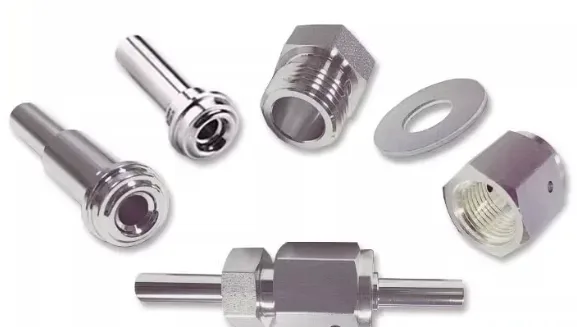
Ask most suppliers how a VCR fitting is made and you get one word back: turned. That answer is fine until you send a set drawing and the quote comes back suspiciously smooth, because what actually happened is that the shop sent the elbows out, or quietly ran the short gland on a lathe that was set up for something else and hoped the thread looked right.
The set is not one part. A short gland is a small, stubby turning job that wants a gang-tool lathe with a lot of tools in the cut and short cycle times. A long gland is a slender turning job with a length-to-diameter ratio that punishes anything loose. Nuts and gaskets are turning as well, but they are a different animal again. And the elbows and tees are milled — there are intersecting bores in them that no single-axis lathe will ever produce.
Which component goes where, and why
This is the split we run, and it has not changed in years:
| Component | Process | What decides quality here |
|---|---|---|
| Short gland | Gang-tool lathe | Tool count in one setup; the face and the thread share a single clamping, so they cannot drift apart. |
| Long gland | CNC turning | Support along a slender body — deflection shows up as a taper nobody asked for. |
| Nuts (male and female thread) | CNC turning | Thread go/no-go discipline, and keeping the hex and the thread concentric. |
| Gaskets | CNC turning | Thin-wall clamping — the part is soft enough that the fixture can dent it before the tool does. |
| Elbows and tees | CNC milling | Intersecting bores and the burr left where they meet; that intersection is where contamination hides. |
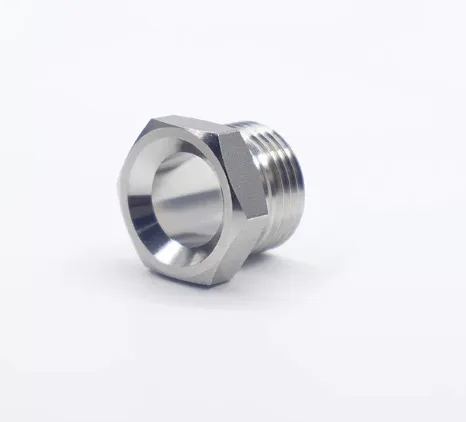
One thing worth saying plainly: this family does not belong on a sliding-head machine. We run Swiss-type lathes for other work, but a VCR gland wants a different kind of rigidity and a different fixture logic, so it goes on the gang-tool lathe and the turning centres instead. A shop that quotes you the whole set off one machine type is either subcontracting quietly or telling you something about how carefully they read the drawing.
Where the polish comes from
Electropolishing is specified on a lot of VCR drawings, and it is the one step we do not own. Our work is turning and milling; the internal electropolish goes to a qualified subcontract partner we have used long enough to know what comes back. We would rather say that than imply a line we do not have, because the buyers who care about surface condition also care about who touched the part, and a straight answer is worth more to them than a vague one.
What this means for your drawing: tell us the finish requirement with the RFQ. If it needs EP, it is quoted as an outside process with the partner's lead time folded in, not buried in a line item.
Two sizes, and no catalogue behind them
We build 1/4 in. and 1/2 in. Everything — glands, nuts, gaskets, elbows, tees — is 316L, including the gasket. No 304 substitute, no alternative gasket material offered as a cheaper option. That is a narrow range on purpose. These parts live in gas lines where a substitution is not a cost saving, it is a future leak with a purchase order attached.
Because the range is narrow and the volumes are not, we do not sell this family on any B2B marketplace and we do not take retail orders. There is no price list and no online cart. What we do take is a long-term programme with an equipment builder: a fixed drawing set, a scheduled release, and a supply relationship that survives more than one purchasing cycle.
Ordering one component instead of the set
Most quotes you will get are for the whole set, and that is often the wrong shape for the buyer. In a real gas panel the consumption is lopsided: gaskets get consumed, nuts get replaced on rebuilds, and the glands themselves last for years. Buying complete sets to get the gaskets means stacking dead inventory behind the line.
So single components are available on their own. If your BOM only consumes the gasket, order the gasket — at the same volume basis as a set order, from 10,000 pieces. The same goes for a nut, a long gland, an elbow. You do not have to buy a family you will not use to get the one part you will.
What a 10,000-set release looks like on our floor
At that volume the interesting problem stops being whether a single part is good and becomes whether the ten-thousandth matches the first. What we control for it is unglamorous: the short gland stays on the same gang-tool machine with the same tool layout across the release, so the face-to-thread relationship does not get re-established by a different setup; tool life is counted rather than sensed, because a worn form tool changes the thread flank before it changes the sound of the cut; and first-article plus in-process checks are scheduled at intervals that scale with the lot, not sampled once and hoped over.
The plant behind this runs 220 machines in Shajing, Bao'an, Shenzhen — 100 machining centres, 50 CNC lathes, and the gang-tool lathes that carry this family — across 5,000 m² with 100+ staff, and ships up to 5 million pieces a month on repetitive work. Terms are EXW Shenzhen only - we are happy to recommend reliable freight forwarders.
If you are an equipment builder with a set drawing and a yearly number rather than a shopping cart, send the drawing and the annual volume, and we will tell you which components we would put on which machine. That answer is usually the first useful thing anyone sends back.
Machining capacity behind this article
- Equipment: 220 machines — 100 machining centres (30 of them 3+2), 50 CNC lathes, 70 Tsugami Swiss-type lathes. This VCR family runs on gang-tool lathes, CNC turning and milling only.
- Tolerance: quoted per drawing on this family; unmarked features default to ISO 2768-m.
- Volume: up to 5 million pieces a month; prototyping 3–7 days, production 7–15 days.
- Materials: 6061/7075 aluminium, 303/304/316 stainless, H59 brass, copper, TC4 titanium, carbon steel.
- Footprint: 5,000 m² in Shajing, Bao'an, Shenzhen; 100+ staff; founded 2013.
- Terms: EXW Shenzhen only — we are happy to recommend reliable freight forwarders.
Address: Building B, 3rd Floor, Haosan Maozhoushan Industrial Zone, Buyong Community, Shajing Street, Bao'an District, Shenzhen | Tel: +86-755-27427365 | Email: mc@chxmetal.com
Frequently asked questions
Is a VCR fitting turned or milled?
Both, depending on the component. Short glands run on gang-tool lathes, and long glands, nuts and gaskets run on CNC turning. Elbows and tees are milled, because their intersecting bores cannot be produced on a single-axis lathe. Treating the whole set as one turning job is how suppliers end up subcontracting the elbows without saying so.
Are VCR fittings a Swiss-type lathe job?
No, and that matters more than it sounds. A VCR gland needs a rigidity and fixture logic a sliding-head machine does not give it, so short glands go on gang-tool lathes and long glands on CNC turning. We run Swiss-type lathes for other work and leave them there.
Which sizes and material do you offer?
1/4 in. and 1/2 in., all in 316L, including the gasket. No 304 substitution and no cheaper gasket material offered as an option. The size range is deliberately narrow because these parts sit in gas lines where a material substitution is a future leak, not a cost saving.
Is electropolishing done in-house?
No. Turning and milling are ours; the internal electropolish goes to a qualified subcontract partner. Quote the finish requirement with your RFQ so it can be priced as an outside process with its lead time, rather than discovered later.
What is the minimum order, and can I buy one component?
10,000 sets for a full family, and single components — a gasket, a nut, a long gland, an elbow — can be ordered on their own at the same volume basis. Gas panel consumption is lopsided, so buying whole sets just to get the gaskets usually means carrying dead stock.
Do you sell on B2B marketplaces?
No. There is no price list, no online cart and no retail channel for this family. We take long-term programmes with equipment manufacturers: a fixed drawing set, scheduled releases, and a supply relationship that outlasts a single purchasing cycle.
Send your drawings for a DFM review and a quotation
STEP, IGES, DXF, DWG or PDF — note the material, quantity and finish. Quotes usually go back within one working day. Email mc@chxmetal.com or use the quote form.