Preventing Chatter in Deep Pocket Milling: What Actually Works
Chatter is a stiffness problem before it is a speed problem. Keep tool overhang under 4× diameter, hold radial engagement at 30–40% of cutter diameter, use a variable-helix cutter, and if it still sings change spindle speed 10–15% rather than dropping the feed. Fixture rigidity matters as much as the tool.
Why do deep pockets chatter?
Chatter is self-excited vibration: the cutter deflects, cuts a slightly thicker chip on the next tooth, deflects further, and the oscillation sustains itself. It needs a flexible element and a forcing frequency that matches it. In a deep pocket both are present — the tool has to be long to reach the bottom, and the wall being cut is thin.
The critical number is the tool's length-to-diameter ratio. Deflection grows with the cube of overhang, so a Ø10 mm cutter at 40 mm overhang is not twice as flexible as at 20 mm — it is about eight times. That is why the same cutter that finishes beautifully at 2× diameter screams at 5×.
What is the single biggest lever?
Shorten the overhang, or make the tool effectively shorter. In order of impact:
- Reduce overhang. Every millimetre removed from the stick-out is worth more than any parameter change. If the pocket is 40 mm deep, use a tool with 45 mm reach, not 70 mm.
- Use a relieved or tapered neck. A cutter with a reduced neck diameter behind the flutes reaches depth without carrying full-diameter stiffness loss. It is weaker in bending but far more stable than a long full-diameter tool.
- Change to a larger diameter where geometry allows. A Ø12 at 4× overhang is stiffer than a Ø10 at 5×, even though the reach is similar.
- Reduce radial engagement. 30–40% stepover with a trochoidal path keeps the chip thin and the load steady, which raises the stable depth of cut dramatically.
If you can only change one thing, change overhang. Parameters tune a flexible setup; they do not fix it.
How do you choose a cutter for a deep pocket?
Work backwards from depth and corner radius. Pocket depth divided by 4 gives the minimum practical diameter for a stable cut; a 60 mm deep pocket therefore wants at least Ø15 mm, which in turn sets the smallest internal corner radius the design can have. If the drawing demands a 3 mm corner at 60 mm depth, the design is asking for a tool that cannot be rigid, and the cost of that decision shows up as slow feeds and hand finishing.
| Pocket depth | Minimum sensible cutter | Smallest inside corner |
|---|---|---|
| 20 mm | Ø6 mm | R3 |
| 40 mm | Ø10–12 mm | R5–6 |
| 60 mm | Ø15 mm | R7.5 |
| 100 mm | Ø25 mm or EDM | R12.5 |
A variable-helix or unequal-pitch cutter helps at the margin: it breaks the regular tooth rhythm that feeds the oscillation, which raises the stable depth of cut by 20–40% in difficult pockets. It does not replace rigidity, it buys tolerance for it.
When is the machine the limiting factor?
If the same tool and program chatter on one machine and not another, the difference is the machine's structural loop — spindle, column, base, and how the part is held. A machine with a worn spindle bearing or a lightweight frame has a lower natural frequency, and the stable speed window narrows.
Fixturing is part of that loop and is usually the cheapest thing to fix. A part held on three points in a vise with 60 mm of unsupported wall will ring no matter what cutter is in the spindle; supporting the wall, filling the pocket with a low-melt alloy, or machining the wall in two stages often removes the problem entirely.
On thin-wall work the sequence matters as much as the support: rough both sides, let the part relax, then finish both sides in a light pass. Machining one wall to final size before the other has been roughed guarantees the finished wall moves.
About the author
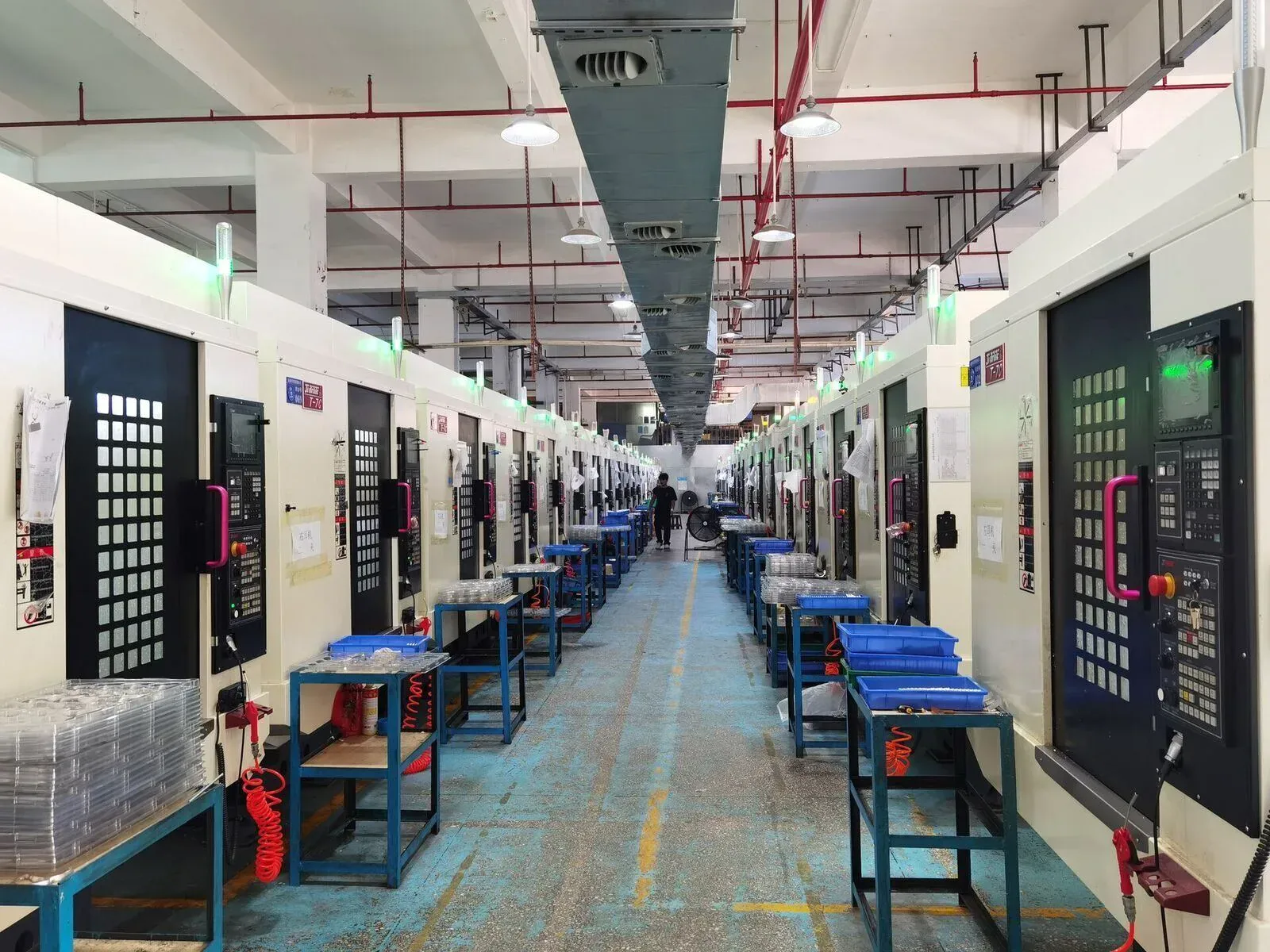
CHX Precision Metal is a precision machining supplier in Shajing, Bao'an District, Shenzhen, founded in 2013. The floor runs 220 CNC machines — 100 five-axis machining centres (30 configured 3+2), 70 Tsugami Swiss-type lathes and 50 CNC lathes — under ISO 9001:2015 and ISO 14001:2015. Standard tolerance is ±0.005 mm, or better where the drawing requires it; prototypes ship in 3–7 working days, production in 7–15, MOQ 1 piece. Capability details: chxmetal.com
Quick answers
Short, self-contained answers to the questions this article is usually asked. Full reasoning is in the sections above.
What causes chatter when milling a deep pocket?
Self-excited vibration driven by tool deflection. The long overhang needed to reach the pocket bottom makes the cutter flexible, and the thin wall being cut is flexible too. When the tooth-passing frequency lines up with the structure's natural frequency, the oscillation sustains itself instead of damping out.
Does slowing the feed stop chatter?
Usually not, and it often makes the surface worse because the tool rubs instead of cutting. The effective parameter change is spindle speed: shifting it 10–15% moves the tooth-passing frequency away from the resonance. Reducing radial engagement is the other reliable lever.
What length-to-diameter ratio should I stay under?
Below 4× diameter for a stable finishing cut in a pocket. Between 4× and 6× you need reduced radial engagement and a variable-helix cutter. Beyond 6×, chatter becomes a design problem — the geometry should change or the feature should be made another way.
Can I machine a 3 mm inside corner in a 60 mm deep pocket?
Not with a rigid cutter — a 3 mm cutter at 60 mm depth is 20× diameter and will chatter or break. The practical answers are a relief at the corner, a larger corner radius, or wire EDM for the corner detail. Specifying it and hoping is the most expensive option.
Related CHX Metal services and notes
- 5-Axis CNC Machining — Five-axis capability for deep pockets and compound angles.
- CNC Machining Services — Milling and turning with DFM feedback in 24 hours.
- 5-Axis DFM Checklist: 12 Design Decisions That Change Cost