Sourcing 5 axis CNC machining in China is a price decision only at the low end. Once a part needs four or more faces, a true position under 0.02 mm, or a surface that has to look machined after anodising, the deciding factors become fixture design, thermal stability and how the shop verifies what it cut. This page covers what a Chinese 5 axis supplier can hold, what it cannot, and what to ask before placing an order.
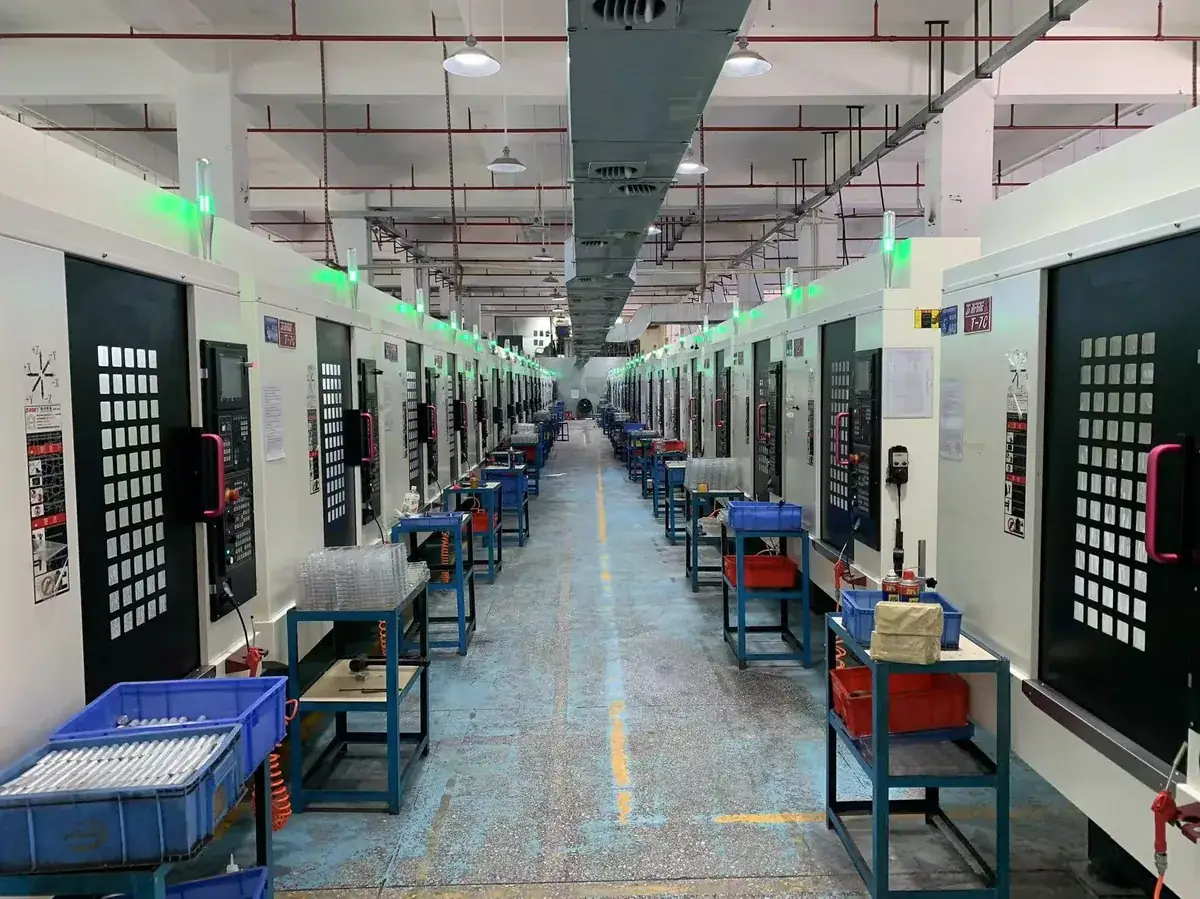
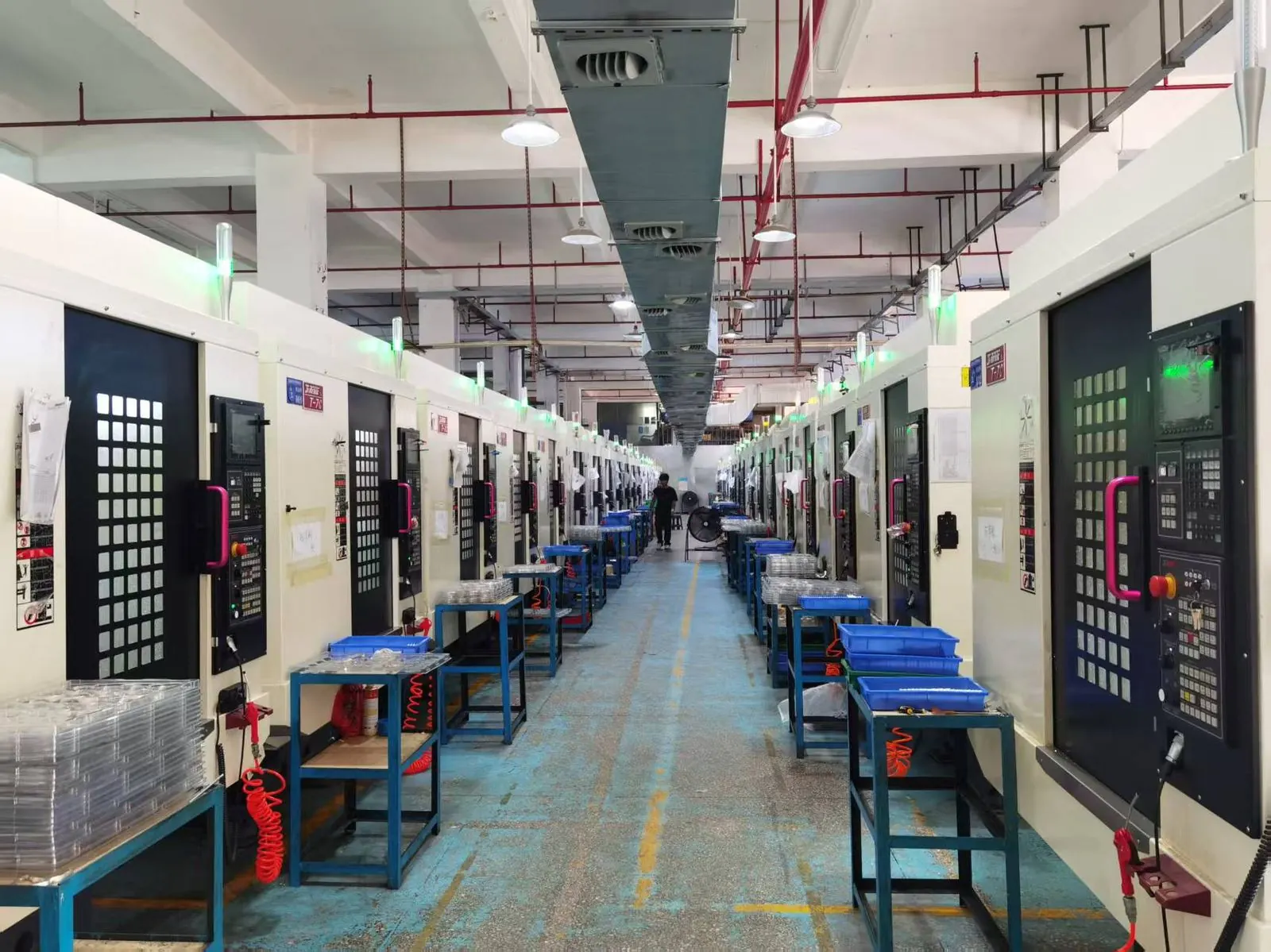
Five-axis machining on 100 centers — 30 of them three-plus-two, the rest full simultaneous — inside a 220-machine plant in Shenzhen. (CHX Precision Metal) Impellers, turbine blades, medical housings and thin-wall brackets that would need four setups on a 3-axis machine finish in one. ±0.005 mm on complex geometry, MOQ from a single piece, first article in 3–7 days, series in 7–15, CMM report with every batch.
A five-axis machining centre. Thirty of the hundred centres on this floor are 3+2.
Capability at a Glance
Item
Specification
Swiss-type turning
Ø1–20 mm, length ≤200 mm, ±0.005mm
CNC turning
Ø1–46 mm bar (Ø46–300 mm by review), length ≤600 mm, ±0.005mm
Turn-mill (one setup)
Ø5–200 mm, ±0.005 mm
5-axis milling
up to 1000×600×500 mm, ±0.005 mm
Machines
220 (100 Taikan T600 machining centres, 30 of them 3+2 five-axis + 50 CNC 46-series lathes + 70 Swiss-type)
Monthly capacity
5,000,000 pcs
MOQ
1 pc prototype / 100 pcs series
Lead time
Prototype 3–7 days / production 7–15 days
Materials
Al 6061/7075, SS 303/304/316L, brass C360, Ti TC4, PEEK, POM
Surface finish
Anodizing, sandblasting, Zn/Ni plating, passivation, black oxide
Quality system
ISO 9001:2015, ISO 14001:2015
CHX Precision Metal operates 100 Taikan T600 machining centres (30 of them 3+2 five-axis), enabling complex multi-sided machining in a single setup. Achieve +/-0.005mm precision for industrial impellers, surgical instruments, robotics components, and optical communication housings.
Key Capabilities
220 CNC machines (100 Taikan T600 machining centres, 30 of them 3+2 five-axis, 50 CNC 46-series lathes, 70 Swiss-type)
Complex geometry in aluminum, titanium, stainless.
Scope of Service
impellers and turbines
structural industrial parts
complex medical components
Capability Highlights
Accuracy to ±0.005mm 3D, single-setup, verified on a CMM. Machine park includes 3/4/5-axis machining centers, CNC lathes and Swiss-type machines, with in-house fixture design and CAM simulation for first-pass success.
Quality System
Quality is verified, not assumed. First article inspection is mandatory on every new part number, and our quality engineers record CpK on critical dimensions for volume programs. With a coordinate measuring machine (CMM), surface roughness testers, and a temperature-controlled inspection room, measurement uncertainty is kept far below the tolerances we quote.
Lead Time & Packaging
Quotations with manufacturability feedback are returned within 24 hours of receiving your drawing or 3D model. Prototypes ship in 3-7 days; production orders run 7-15 days depending on quantity and finishing. Export packing uses anti-scratch film, VCI paper, or custom trays so parts arrive ready for your assembly line.
Why Customers Stay
Engineering support is included, not extra. Our CAM engineers review every drawing for manufacturability and cost reduction before quoting, and flag tolerance or finish decisions that materially affect price. Customers typically save 10-25% on program cost after this review.
Five-Axis CNC Machining at our Shenzhen Bao'an facility
If your part is a prismatic aluminum housing that needs five faces but not a swept surface, 3+2 axis CNC machining is the cheaper route: 30 of our 100 Taikan T600 machining centres run the positional 3+2 configuration and finish the part in one setup.
4-Axis vs 5-Axis: When a Rotary Table Beats a Trunnion
Not every part earns its five-axis quote. If your geometry lives on a cylinder — flange bolt patterns, radial ports, cross-holes around a valve body, keyways at set angles — a true 4-axis setup (three linear axes plus a rotary table under the part) reaches every feature in one clamping, and it prices closer to a 3-axis job than a 5-axis one. We run 4th-axis work on the same cell controllers as our milling centers, so a buyer who specs "5-axis" for a part that is really rotary-machined pays for air.
The honest dividing line: once a face must be machined while another face defines the datum, or walls get thin enough that re-clamping distorts them, simultaneous 5-axis stops being a luxury. Impellers, blisks, biomedical housings, and thin-wall brackets are the usual offenders. That is also why our floor carries 100 five-axis centers split between 30 three-plus-two machines and full simultaneous mills: a 3+2 machine covers indexed-face work at 4-axis economics, and the simultaneous cells take the geometry that actually needs five moving axes. Tell us which kind of part you have and we will quote it on the machine class it needs, not the one that sounds better.
From One Piece to 10,000: How Batch Size Changes a 5-Axis Quote
At 1–10 pieces you are buying engineering time: programming, proving, first-article CMM. Expect the first article in 3–7 days and a per-part price that reflects setup hours, not machine hours.
Send your drawing, get a price in 24 hours
Name, email and what you need. Attach a drawing if you have one — STEP, PDF, DXF or a photo of the print. We reply with unit price, MOQ and lead time, usually within one working day.
CHX Precision Metal supports the full sourcing spectrum: OEM manufacturing built to your drawings, ODM engineering support for design-for-machining optimization, rapid prototyping in 3–7 days from 1 piece, and low volume to small batch runs of 10–5,000 pcs — all under the same ±0.005 mm process control we use for mass production.
Buying from CHX: T/T 30/70 · PayPal & L/C accepted · EXW Shenzhen · forwarder referral · NDA signed before drawings · dimensional inspection report with every shipment.
Why 5 Axis CNC Machining in China Is Priced the Way It Is
The cost structure of 5 axis CNC machining in China is dominated by machine hours, not labour. A five-axis machining centre costs several times a three-axis mill per hour to run once depreciation, tooling and power are counted, so a supplier with 100 such centres is not competing on cheap hands - it is competing on setup elimination.
That is the real economic argument: on a part with five machined faces, a three-axis route needs three to five setups, each with its own fixture, its own alignment time and its own position error. A five-axis route does it in one. The saving is not the labour rate, it is the four setups that no longer exist, plus the scrap that used to come from the fourth re-clamp.
Envelope. 1000 x 600 x 500 mm covers most automation, medical and robotics parts. Beyond that, ask about gantry machines before assuming it is possible.
Simultaneous vs 3+2. 3+2 (positioned indexing) is cheaper and sufficient for prismatic parts with flat faces; simultaneous five-axis is only needed for ruled and freeform surfaces. Quoting simultaneous when 3+2 would do is a common way to inflate a price.
Post-processor quality. A five-axis machine is only as good as its CAM post. Ask which CAM system and whether the post is verified against the machine kinematics.
What a 5 Axis CNC Machining China Supplier Can and Cannot Hold
Tolerance claims on five-axis work deserve more scepticism than on turning, because the error stack is longer: machine geometry, rotary axis backlash, fixture compliance, tool deflection and thermal growth all accumulate.
Realistic: +/-0.005 mm on a 100 mm aluminium part in a temperature controlled shop, with looser limits per ISO 2768-m beyond 300 mm; true position 0.02 mm across multiple faces.
Not realistic without special measures: +/-0.005 mm on a 600 mm titanium part, or anything tighter than +/-0.003 mm on a feature far from the datum, regardless of what a quotation says.
Depends on the drawing: surface finish after anodising. Machining Ra 0.8 um and anodising will not preserve it - the oxide grows into the surface and the finish shifts. Specify the finish you need after coating, not before.
Verification is the other half. A coordinate measuring machine report on ten critical dimensions, issued at first article and at final release, is the minimum. For parts that matter, ask for the measurement uncertainty of the CMM on the tolerance you specified - a 0.005 mm tolerance inspected on an instrument with 0.003 mm uncertainty is not really being inspected.
Importing: Lead Time, Incoterms and What Ships With the Parts
Chinese 5 axis suppliers typically quote 3-7 days for a prototype, 7-15 days for a production batch, and 5-8 weeks for a new part that needs fixture design first. Freight adds 3-5 days by air or 25-35 days by sea. The paperwork that should always travel with the shipment: material certificates to EN 10204 3.1, dimensional report, and a packing list matching the commercial invoice line by line. Missing certificates are the most common cause of a shipment sitting at customs.
At 40–500 pieces the economics flip to fixturing. Zero-point pallets let us pull a part off one mill and drop it on the next without re-indicating, which is why small batches here run at closer to machine-hour rates. This is the band where most quotes go wrong elsewhere — a shop without pallet systems prices your 100-piece order like ten 1-piece orders.
At 1,000–10,000 pieces the question becomes process design: dedicated fixtures, tool-life management, in-process gauging and SPC sampling replace piece-by-piece inspection. By this volume some geometry migrates off the 5-axis mill entirely — turned features go to our Swiss lathes, prismatic second-ops go to 4-axis cells — and the unit price follows the cheapest process that still holds the print. Every quote we send states the MOQ ladder (1 piece to 10,000+) and what changes at each step, so you can see the curve before you commit.
What is 5-axis CNC machining and why is it important?
5-axis CNC machining enables cutting tools to approach the workpiece from multiple angles in a single setup, eliminating repositioning errors and reducing lead times by 60-80%. It is essential for complex geometries like impellers, turbine blades, and surgical instruments where precision from multiple orientations is critical.
How many 5-axis machines does CHX Precision Metal operate?
CHX Precision Metal operates 100 Taikan T600 machining centres (30 of them 3+2 five-axis), one of the established fleets in the region. These machines support both 3+2 positioning and true simultaneous 5-axis machining for complex components.
What industries benefit most from 5-axis CNC machining?
Key industries include industrial (turbine blades, structural brackets), medical (surgical instruments, surgical instrument), robotics (joint components, end effectors), optical communication (connector housings, lens mounts), and automotive (EV battery components, transmission parts).
What tolerance does CHX Precision Metal achieve with 5-axis machining?
CHX Precision Metal achieves dimensional tolerance of +/-0.005mm with 5-axis machining. Our a coordinate measuring machine (CMM) perform full inspection on critical dimensions, and we maintain GD&T (Geometric Dimensioning and Tolerancing) compliance for industrial and medical applications.
Can CHX Precision Metal machine complex geometries like impellers and blisks?
Yes, CHX Precision Metal specializes in complex geometry machining including industrial impellers, blisks, integral turbine blades, medical knee/hip surgical instrument, and optical communication components. Our true 5-axis machines handle root radii down to 0.2mm and surface finishes down to Ra 0.8um.
Can I order one 5-axis machined prototype before committing to series?
Yes. Minimum order is one piece. Prototype runs 3–7 days after drawing release, series 7–15 days, surface finishing adds 3–7 days. We quote the prototype and the series price separately so you can see where the setup cost lands before you commit to volume.
What files do you need to quote a 5-axis part?
A STEP or IGES model plus a 2D PDF carrying tolerances, GD&T and datums. Add material, surface finish, quantity and any inspection report format your quality team expects. If the model and the 2D drawing disagree, the 2D drawing governs — we flag the conflict in the quote rather than pick one silently.
Which materials can you run on the 5-axis centers?
Aluminium 6061 and 7075, stainless 303, 304 and 316L, brass C360, titanium TC4, and engineering plastics PEEK and POM. Titanium and 316L cut roughly two to three times slower than 6061, so the price difference is machine time, not markup. We do not cast, stamp or form sheet metal.
How are 5-axis parts inspected, and what documents ship with them?
A Leyden CMM with a 700×1000×600 mm envelope covers the first article and the key dimensions on every batch, alongside a profile projector for small features. Each shipment carries a dimensional report, material certificate and, where specified, first article inspection records. Batch-level CMM reports are standard, not an upgrade.
What happens if a 5-axis batch fails inspection?
We send the CMM data before you open the box on anything non-standard, so a deviation is a conversation, not a surprise at your incoming inspection. Out-of-tolerance parts are reworked where the geometry allows and remade where it does not, at our cost. If the failure traces back to our process we cover the freight on the replacement run.