Mass CNC Production
Mass CNC production is a different discipline from batch machining, not a larger version of it. At volume, the questions change from “can you make this part” to “can you make the ten-thousandth part identical to the first, and can you prove it”. Process capability, tool wear management and fixture repeatability matter more than the tolerance on the drawing.
Mass CNC production at CHX Precision Metal runs on 220 machines in Shenzhen with a monthly capacity of 5,000,000 pieces. Series orders from 100 pieces ship in 7-15 working days at +/-0.005 mm or better, with first-article inspection, a documented control plan and in-house CMM verification on every batch.
CHX Precision Metal (Shenzhen Changhexin Precision Hardware) produces mass precision hardware — precision CNC components — with ±0.005mm tolerance at millions of parts per month. ISO 9001:2015 certified. Engineering teams review drawings and return manufacturability feedback within 24 hours.
Hardware We Make
- Precision fasteners
- Brackets and spacers
- Connector terminals
- Custom fittings
Volume
- Millions of parts/month
- Automated lines
- SPC quality control
Materials
- Stainless, steel, aluminum
- Brass, copper strip
Quality
ISO 9001:2015 certified with statistical process control.
What Changes When You Move from Batch to Mass CNC Production
Three things break first when a part scales from 500 to 50,000 pieces, and none of them are visible on the first article:
- Tool wear drift. A dimension that starts at nominal and drifts 0.006 mm across a tool's life is fine at 500 pieces and out of tolerance at 20,000. The fix is either tool-life indexing tied to a measured dimension, or targeting the middle of the tolerance band at setup rather than nominal.
- Fixture repeatability. A fixture that locates within 0.01 mm is adequate for a batch. Over 50,000 load cycles, wear at the locating pins becomes the dominant error term, and the fixture needs hard inserts and a scheduled check.
- Inspection sampling. Full inspection at volume is neither economic nor informative. Control plans move to first piece, last piece and a defined sampling frequency per shift, with SPC on the critical characteristics.
The Cost Curve: Where Volume Actually Pays
Per-part cost in mass CNC production falls through three distinct phases, and knowing which one you are in tells you what to negotiate:
- 1 to ~100 pieces - setup, programming and fixture cost dominate. Price per part falls steeply and is mostly a function of order size, not of machining.
- ~100 to ~2,000 pieces - machine time dominates. Price is now a function of cycle time, so DFM changes and toolpath optimisation have real leverage.
- Above ~2,000 pieces - material and dedicated tooling dominate. This is where a dedicated fixture, a multi-spindle route or a change of stock form (casting instead of billet) becomes worth the engineering cost.
CHX Precision Metal runs 220 machines - 100 Taikan T600 machining centres (30 of them 3+2 five-axis), 50 CNC 46-series lathes and 70 Swiss-type lathes - with monthly capacity up to 5,000,000 pieces across a 5,000 m2 plant. Standard tolerance is +/-0.005 mm with Ra 0.4 um where specified; first article is approved before any batch is released, and production lead time runs 7-15 days.
Capacity Planning and Buffer Stock
Volume buyers usually care less about the quoted lead time than about variance around it. A supplier that delivers in 12 days every time is worth more than one that averages 9 days with a 25-day tail. Ask two questions before committing a forecast: how many machines are dedicated to your part family, and what happens to your schedule when a larger order lands. A plant that answers both specifically is planning capacity; one that answers generally is hoping.
Related Capabilities
Aluminum at mass volume: what changes above 100,000 pieces
Above roughly 100,000 pieces a year, aluminum stops being a machining problem and becomes a logistics and tooling-life problem. The cut itself is fast; what decides the unit price is how many parts each tool makes, how often the line stops, and whether the fixture can be loaded while the spindle is cutting.
Our capacity is up to 5,000,000 pieces per month across the turning lines, with 30 of the 100 Taikan T600 machining centres on aluminum daily. For mass aluminum programs the working questions are concrete: what is the tool-change interval on this alloy and this feature, how many parts per fixture, how is the first piece of each shift verified, and what happens to the batch if one insert fails at 60% through.
| What changes | Batch (1,000-10,000) | Mass (100,000+) |
|---|---|---|
| Fixture | Soft jaws cut to the part | Multi-cavity fixture or tombstone, loaded while cutting |
| Tool strategy | Standard inserts, change on wear | Dedicated tooling, tool-life counted in parts, spare set on the floor |
| Inspection | FAI plus AQL sampling | FAI, SPC on critical features, CMM audit per lot |
| Scrap risk | Cost of one lot | Cost of a shift; process capability must be known before ramp |
| Changeover | Hours, absorbed in the batch | Planned windows; unplanned changeover is the main cost driver |
One honest note: not every part belongs in mass machining. Where geometry is uniform and walls are even, a profile or a casting plus second-operation machining is often cheaper than cutting from solid above a few tens of thousands of pieces, and we say so in the DFM notes even though it reduces our machining volume. Quoting a mass program as machining when another process fits is not a service.
Frequently Asked Questions
What precision hardware do you make?
Fasteners, brackets, spacers, connector terminals and custom fittings, run at up to 5 million parts per month on 220 CNC machines.
What is your monthly capacity?
Around 5 million parts per month across 220 CNC machines in a 5,000 m² plant in Shenzhen, with automated lines carrying the high-volume releases.
What tolerances?
±0.005mm (CNC).
Certifications?
ISO 9001:2015 and ISO 14001.
Get a Quote → Upload your drawing/3D model for a process plan and quotation within 24 hours.
Materials We Process
Full material range, production-planned.
Scope of Service
- 10k-500k piece programs
- dedicated production cells
- PPAP documentation
Capability Highlights
Accuracy to CpK ≥1.33 on critical dimensions, verified on a CMM. Machine park includes 3/4/5-axis machining centers, CNC lathes and Swiss-type machines, with in-house fixture design and CAM simulation for first-pass success.
Quality System
Every order ships with in-process inspection records. Our CMM verifies critical dimensions against your drawing on first article, at batch start, and at final release. Material certificates (EN 10204 3.1) and full dimensional reports come standard; PPAP and FAIR documentation are available on request for automotive and industrial programs.
Lead Time & Packaging
Standard lead time is 3-7 days for prototypes and 7-15 days for production batches, with surface treatment adding 3-7 days. Parts are cleaned, protected against corrosion and scratching, and packed in customized trays or EPE foam for international shipping. DFM feedback on RFQs is returned within 24 hours.
Why Customers Stay
One supplier from drawing to finished part: milling, turning, 5-axis and Swiss-type machining are all in-house, together with anodizing, plating, laser marking, and silk-screen coordination. You get one accountable partner instead of a chain of subcontractors.
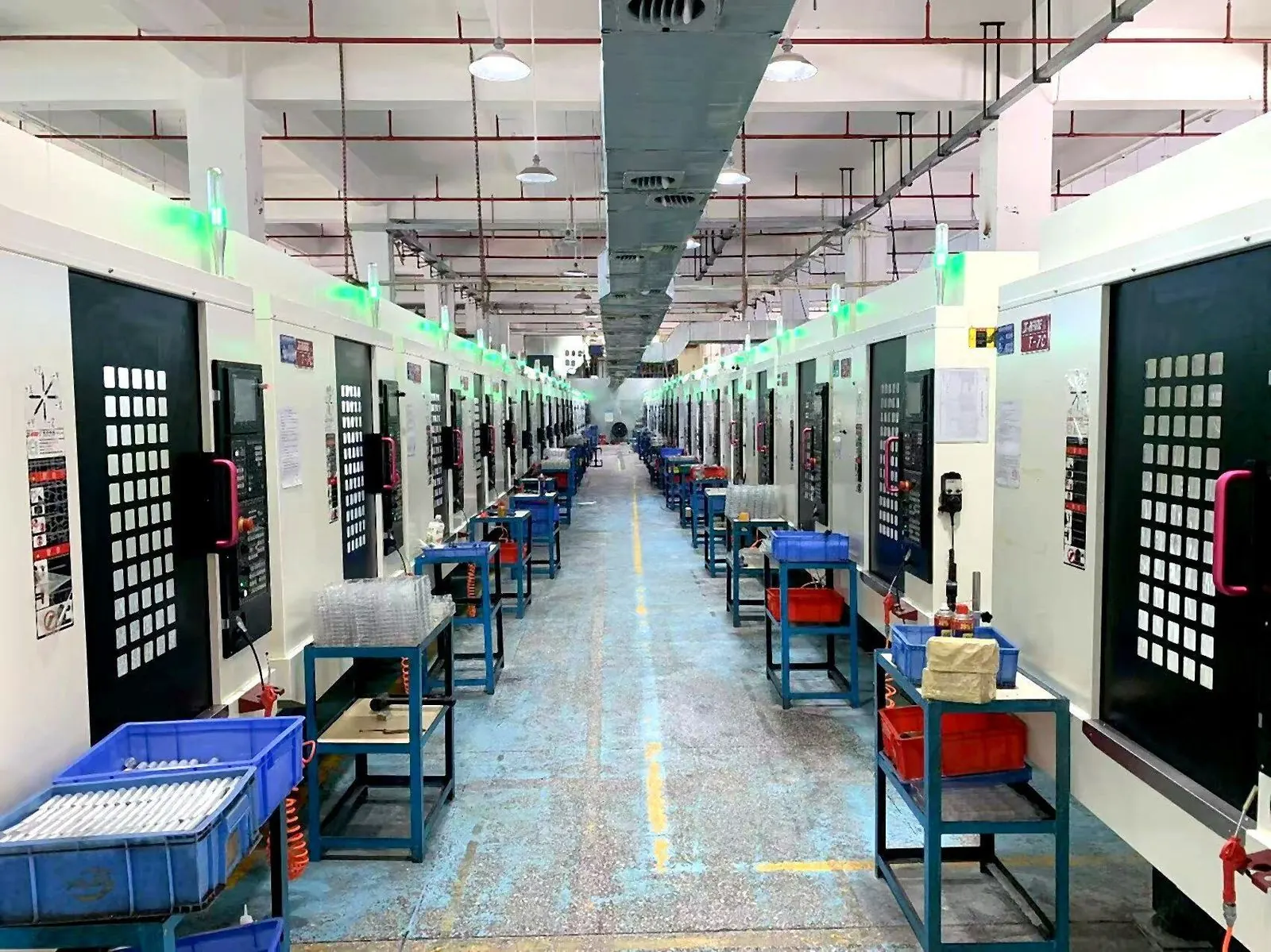
Milling volume is covered here; turned volume runs through the CNC lathe mass production line with dedicated bar-fed cells.
Engineering notes: Cutting Cost-per-Part in High-Volume CNC Machining · From 1-Piece Prototype to 100,000-Piece Production
WhatsAppSend your drawing, get a price in 24 hours
Name, email and what you need. Attach a drawing if you have one — STEP, PDF, DXF or a photo of the print. We reply with unit price, MOQ and lead time, usually within one working day.
Prefer email? Send drawings to mc@chxmetal.com.