CNC Lathe Mass Production
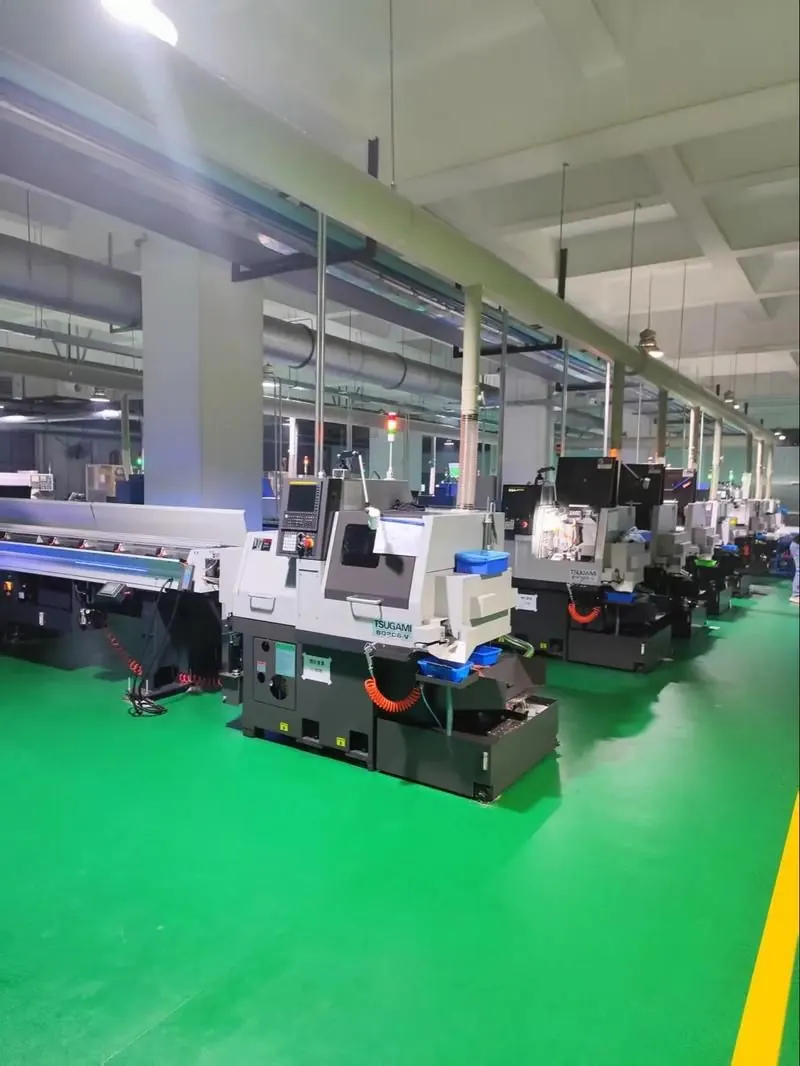
CHX Precision Metal runs 50 CNC 46-series lathes to Ø300 mm and 70 Swiss-type lathes, across 220 machines and 5,000,000 pieces a month. Turned diameters hold ±0.005 mm, production runs ship in 7-15 days from 1 piece, and volume programs get a fixed unit rate on an annual contract.
Mass production CNC lathe services. 70 Swiss-type lathes, 5M PCS/month capacity. Engineering teams review drawings and return manufacturability feedback within 24 hours.
Our Capabilities
- 220 CNC machines (100 Taikan T600 machining centres, 30 of them 3+2 five-axis, 50 CNC 46-series lathes, 70 Swiss-type)
- Standard tolerance: +/-0.005mm | Precision: +/-0.005mm or better
- Materials: Aluminum 6061/7075, Stainless 304/316, Titanium TC4, Brass, PEEK
- Surface treatment: Anodizing, electroplating, powder coating
- Inspection: a coordinate measuring machine (CMM) for full quality control
- Capacity: 5,000,000 PCS/month
Request a Quote
Email: mc@chxmetal.com
WhatsApp: +86-181-3885-0989
Materials We Process
Bar stock Ø1–300 mm (turning Ø1–46 mm; Ø46–300 mm by review): aluminum, free-cutting steel, stainless, brass.
Scope of Service
- drive shafts and pins
- bushings and sleeves
- hydraulic fittings
- custom fasteners at volume
Capability Highlights
Accuracy to ±0.005mm turned diameters, verified on a CMM. Machine park includes 3/4/5-axis machining centers, CNC lathes and Swiss-type machines, with in-house fixture design and CAM simulation for first-pass success.
Quality System
Every order ships with in-process inspection records. Our CMM verifies critical dimensions against your drawing on first article, at batch start, and at final release. Material certificates (EN 10204 3.1) and full dimensional reports come standard; PPAP and FAIR documentation are available on request for automotive and industrial programs.
Lead Time & Packaging
Standard lead time is 3-7 days for prototypes and 7-15 days for production batches, with surface treatment adding 3-7 days. Parts are cleaned, protected against corrosion and scratching, and packed in customized trays or EPE foam for international shipping. DFM feedback on RFQs is returned within 24 hours.
Why Customers Stay
One supplier from drawing to finished part: milling, turning, 5-axis and Swiss-type machining are all in-house, together with anodizing, plating, laser marking, and silk-screen coordination. You get one accountable partner instead of a chain of subcontractors.
Frequently Asked Questions
Turning Materials & Finishes?
Common bar stock includes aluminum 6061/2024, free-cutting steel 1214/12L14, carbon steel 45#, alloy 40Cr, stainless 303/304/316, and brass C3604. Deburring, tumbling, passivation, black oxide, zinc and nickel plating are all available so parts arrive ready for assembly.
Materials We Process?
Bar stock Ø1–300 mm (turning Ø1–46 mm; Ø46–300 mm by review): aluminum, free-cutting steel, stainless, brass.
Lead Time & Packaging?
Standard lead time is 3-7 days for prototypes and 7-15 days for production batches, with surface treatment adding 3-7 days. Parts are cleaned, protected against corrosion and scratching, and packed in customized trays or EPE foam for international shipping.
Volume Turning Equipment
High-volume turning runs on multi-turret CNC lathes with bar feeders and parts catchers for lights-out operation. For long slender parts below 20mm diameter we move jobs to Swiss-type automatic lathes where guide bushings support the workpiece right at the cutting point, holding concentricity and finish across thousands of parts. Turrets carry redundant tooling so worn inserts are swapped without stopping the spindle, and robotic loaders keep spindle utilization above 85% on scheduled programs.
Turning Materials & Finishes
Common bar stock includes aluminum 6061/2024, free-cutting steel 1214/12L14, carbon steel 45#, alloy 40Cr, stainless 303/304/316, and brass C3604. Deburring, tumbling, passivation, black oxide, zinc and nickel plating are all available so parts arrive ready for assembly. Threads (metric, UN, NPT), knurling, grooves and cross-milling features are machined complete in one setup wherever possible to eliminate tolerance stack-up between operations.
What Changes When the Volume Goes Up
At 100 pieces, the cost of a turned part is mostly the quote, the setup and the first-article inspection. At 100,000 pieces those three items are noise, and three other numbers decide the price: cycle time, tool life and scrap rate. A few seconds of cycle time is worth more than a percentage point of material cost, and one percent of scrap at volume costs more than the entire tooling budget.
That changes how the job is planned. Cam programs are written for constant chip load rather than for a safe first pass. Inserts are chosen for the material lot, not for the catalogue. Bar feeders run unattended through the night, and the parts catcher, chip conveyor and coolant pressure are treated as production equipment rather than accessories. Gauges move to the machine: in-process probing and go/no-go checks at a fixed interval, so a drift is caught between parts instead of between lots.
The setup itself is amortised across the whole order, which is why volume work is worth fixturing properly. Dedicated collets, hard stops and pre-set tooling stay with the program, so the second release runs on the same offsets as the first and the parts do not drift between batches.
Capacity You Can Plan Against
Volume quotes are only useful if the capacity behind them is real. The numbers we quote against: 50 CNC 46-series lathes covering bar and chuck work from Ø1 mm to Ø300 mm, 70 Swiss-type automatic lathes for long slender parts where a guide bushing supports the workpiece at the cutting point, and 220 machines in total inside a 5,000 m2 plant. Monthly output reaches 5,000,000 pieces.
For repeating programs we hold a dedicated cell: the machines, the tooling and the inspection gauges stay assigned to that part number, and the operator runs the same setup sheet every release. Delivery runs against a blanket order with weekly or monthly releases, Kanban call-offs or VMI, and agreed safety stock covers your line while the next lot is in process. If a program grows past the cell, the second cell is built from the same program and the same fixture design rather than re-engineered.
Where the Money Goes at 100,000 Pieces
Four cost lines dominate a high-volume turned part, in roughly this order: material, machining time, tooling, and inspection. Each one has a different lever.
- Material. Bar stock is bought to the finished diameter plus allowance. Every 0.5 mm of extra bar diameter is metal that becomes chips on every part, so bar size is reviewed against the drawing before the first order, not after.
- Machining time. Cycle time is set by the slowest operation, not the fastest. On a multi-turret lathe, balancing the two turrets so neither waits is worth more than raising the cutting speed, which shortens tool life and adds a tool-change every few hundred parts.
- Tooling. Insert cost per part is tool price divided by parts per edge. A cheaper insert that lasts half as long usually costs more at volume, and a tool-change stopped mid-lot costs more than either.
- Inspection. At volume, 100% inspection is a cost with no defect-prevention value. Sampling at a fixed interval, with SPC charts on critical dimensions, catches drift earlier and costs a fraction of sorting every part.
Scrap sits across all four. The scrap rate at volume is set by the process, not the operator: bar-end remnants, tool breakage, and parts that drift out of tolerance late in a run. Each of those is a process decision made before the first part is cut.
Process Control at Volume: SPC and Cpk
A high-volume part is not proven by a good first article. It is proven by the distribution of 5,000 parts. On critical dimensions we run SPC: subgroups measured at a fixed interval, control limits set from the process capability rather than from the drawing, and a reaction plan that says what the operator does when a point sits outside the limit.
Capability is reported as Cpk on the dimensions that matter, typically the turned diameter, the shoulder length and any bore-to-face relationship. A process that is capable but not controlled will still ship bad parts on a bad night, which is why the chart matters as much as the number. Gauge repeatability is checked before the run, so a variation on the chart is the process moving and not the gauge drifting.
Every lot ships with the inspection record for that lot, not a generic certificate. For regulated buyers we add material certificates by heat number and full dimensional reports on the agreed sample size.
Annual Contracts & Scheduled Delivery
For repeating programs we quote an annual price with a fixed unit rate, so budgeting stays predictable. Delivery can run against a blanket order with monthly or weekly releases, Kanban call-offs or VMI, and we hold agreed safety stock to cover your line. Parts ship on a schedule rather than in one large lot, which keeps your inventory lean.
Turned Parts We Produce at Volume
- fasteners, studs and pins
- bushings, sleeves and spacers
- hydraulic and pneumatic fittings
- connector bodies and adapters
- shafts, axles and pivot pins
- inserts and threaded bushings
Typical volumes run from a few thousand to several million pieces per year across multi-year programs.
Engineering notes: Cutting Cost-per-Part in High-Volume CNC Machining
WhatsAppSend your drawing, get a price in 24 hours
Name, email and what you need. Attach a drawing if you have one — STEP, PDF, DXF or a photo of the print. We reply with unit price, MOQ and lead time, usually within one working day.
Prefer email? Send drawings to mc@chxmetal.com.