Gripper Finger CNC Machining | Custom Jaws | CHX Metal
A gripper finger is a wear part, and what matters is whether the grip faces stay parallel after ten thousand cycles. We machine jaws in matched pairs from 7075-T6 or 45 steel, harden the serrations where the drawing asks for it, and check the two faces parallel before the parts leave. One piece to start.
CHX Metal (Shenzhen Changhexin Precision Hardware) machines gripper fingers and jaws for pneumatic and electric grippers on assembly, pick-and-place and machine-tending cells. Most of it is replacement and custom fit work: the OEM jaw broke, or the part changed shape and the jaw has to follow. 220 machines, ISO 9001:2015 and ISO 14001:2015.
What we make
- Gripper fingers and jaws, matched in pairs
- Serrated jaws and hard-stop jaws
- T-slot and dovetail insert jaws
- Mounting interfaces for SCHUNK, Zimmer, SMC and Robotiq footprints
- Fingers with integrated sensors pockets or Locline lines
- V-block jaws for round stock and tube
The two things that go wrong
First: the grip faces drift out of parallel. A jaw that grips at 0.05 mm taper holds a machined part badly and holds a polished one worse, and nobody notices until the part rotates in the gripper after a few thousand cycles. We machine jaws in pairs from the same setup where we can, then measure the two faces together — 0.01 mm parallelism across a 40 mm face is our normal callout, and it costs nothing extra to hold it while the part is in the machine.
Second: the finger bends near the root. The OEM finger was aluminium because it was cheap to cast, and your application doubles the payload. If a customer tells us the load we will propose 45 steel or 40Cr instead and say honestly that it adds weight to the gripper. Sometimes the answer is still aluminium — a heavier finger costs cycle time on a fast delta arm, and the customer knows their robot better than we do.
Serration is the third conversation, and it is usually a wrong turn. People specify fine serrations for sheet metal, then the sheet marks. Coarse serrations hold castings but mark them too. For anything with a finish, the answer is a flat face with a soft insert or polyurethane pad, and we will say that instead of selling you serrations.
Materials
- 7075-T6 — the default finger material, light and stiff, anodised
- 45 steel / 40Cr — through-hardened 28-32 HRC when the jaw sees impact
- SUS304 — cleanroom and food handling
- Insert pads: polyurethane, NBR, or PEEK for temperature
Heat treatment is outsourced to a shop we have used for years, and we say so. Induction hardening of serrations to 50+ HRC, or through-hardening of the whole finger, are both available; tell us which surface actually needs to survive, because hardening the whole finger makes it brittle at the root.
Quality
ISO 9001:2015 and ISO 14001:2015. That is the whole certificate list. No IATF 16949, no AS9100, and we will not pretend otherwise.
First article on every new part number with the CMM report attached: grip face parallelism, bore or dowel positions, thickness. Traceability is lot level. Wear parts get measured where they fail, so if you have a specific check that predicts failure on your line — face width, serration depth — put it in the drawing and we will report it every batch.
Frequently Asked Questions
Which grippers do you make fingers for? SCHUNK, Zimmer, SMC and Robotiq mounting patterns, and any custom footprint. Send the gripper model with the drawing, or just the broken jaw.
Serrations or a flat face? Flat faces with a polyurethane pad for anything with a finish. Serrations for castings and raw forgings. If you are not sure, tell us the part and we will say which one survives.
What hardness can you get to? Through-hardening to 28-32 HRC, or induction hardening of the teeth to 50+ HRC. Heat treatment is outsourced to a shop we have used for years, and we say so on the quote.
Can you match an existing jaw without a drawing? Yes. Post the worn or broken jaw, we measure it, send the revised drawing for approval, then cut. One piece is fine.
What are MOQ and lead time? One piece for a prototype, 3 to 7 working days. Repeat batches 7 to 15 working days, surface finishing 3 to 7 more. EXW Shenzhen.
Get a Quote → Send the gripper model and the drawing, or just the broken jaw — we can work from a sample for one piece.
Materials & Specifications
Finger length 15 to 300 mm, grip faces up to 120 mm. Tolerances to ±0.005 mm on locating features, 0.01 mm parallelism on matched grip faces as the standard callout. Serrations from 0.5 to 3 mm pitch. Aluminium, medium carbon steel and stainless, machined to your 2D drawing or 3D model, or to a sample.
Typical Applications
- Machine tending cells on lathes and presses
- Pick-and-place on packaging lines
- Wheel and hub handling in automotive tier plants
- Sheet metal destacking with padded jaws
- Collaborative robot grippers with custom fingers
The list is what comes through the door most often. If your jaw is stranger than these, it is still worth a drawing.
Our Machining Capability
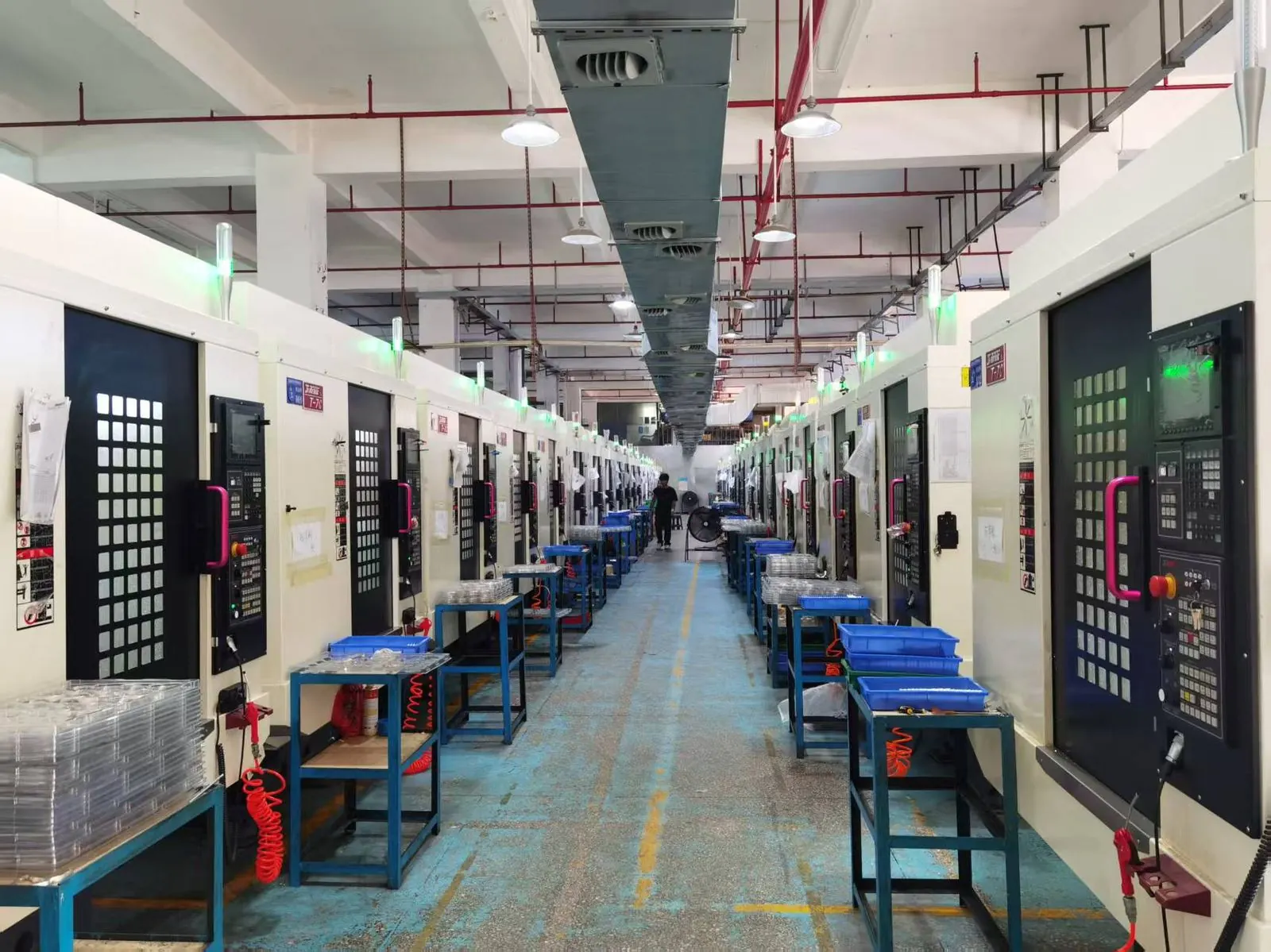
100 CNC machining centres, 30 of them 5-axis, plus 50 CNC lathes and 70 Tsugami Swiss-type lathes — 220 machines, 5,000 m² in Shajing, Bao'an. Jaw work is mostly 3-axis and 4-axis: the body comes off the machining centre in one setup, the serrations get cut with a form tool rather than a 3D path, because a form tool leaves a consistent tooth shape over thousands of pieces and a 3D path does not.
Monthly output across the shop is about 5 million pieces, most of it small turned hardware. A gripper finger set is a 20 to 500 piece job with a short life in service, so what the customer actually buys is the ability to reorder the same part in six months. Drawings are archived against part number, and a reorder goes straight to the machine without re-quoting the geometry.
Surface Finishing Options
Clear or black anodising on aluminium, with masking on the grip faces if the pad glues on. Black oxide and zinc or nickel plating on steel. Pads and inserts are bonded before shipping if you send the pad spec. Cosmetic surfaces are inspected under fixed lighting against agreed criteria.
MOQ, Lead Time & Packaging
One piece is a valid order. Prototype 3 to 7 working days, repeat batches 7 to 15, surface finishing adds 3 to 7. EXW Shenzhen — we will recommend freight forwarders we have shipped with, and the export booking stays with you. Jaws ship in matched pairs in one bag so they cannot get separated in receiving, with the inspection report in the box.
Why CHX Metal
Thirteen years in the same building in Bao'an, 30 minutes from Shenzhen airport, about 100 people. The useful part of that for a wear part is not price. It is that a reorder in March quotes against the same archived drawing as the first batch in October, and the new jaws arrive the same shape as the ones that just wore out.