Material Selection for Optical Communication Housings
6061-T6 is the default for optical housings: it machines cleanly, anodizes predictably and holds ±0.005 mm on cavity features. 7075-T6 is chosen when stiffness or thin-wall durability matters, and kovar only when the housing is welded to glass and its 5.1 ppm/K expansion has to match the fibre feedthrough.
What does an optical housing actually demand?
An optical transceiver or pump housing is not a structural part. Its job is to hold a lens, a fibre ferrule or a laser diode in alignment to a few microns, and to keep that alignment across a temperature range of −40 °C to +85 °C. The mechanical load is trivial; the thermal and dimensional behaviour is everything.
That reframes the material question. You are not selecting for strength. You are selecting for:
- Coefficient of thermal expansion (CTE) close to whatever the housing is bonded or welded to.
- Machinability at tight tolerance, because cavity position and bore alignment are usually ±0.005 mm and sometimes tighter.
- Plating or anodizing compatibility, since the surface has to survive soldering, welding or epoxy cure without outgassing.
- Stability over time — a material that creeps under a preload loses alignment in months, not hours.
How do the three main materials compare?
| Property | 6061-T6 | 7075-T6 | Kovar (FeNiCo) |
|---|---|---|---|
| CTE (ppm/K) | 23.6 | 23.6 | 5.1 |
| Tensile strength | 310 MPa | 570 MPa | 480 MPa |
| Machinability | Excellent | Good — sharper tools, more coolant | Poor — gummy, work-hardens |
| Anodizing | Very good, predictable colour | Good, slightly darker finish | Not applicable; plating instead |
| Typical use | Housings, lens barrels, brackets | Structural frames, thin walls | Glass-to-metal feedthroughs, laser welds |
| Relative cost (material) | 1.0 | 1.4 | 6–10 |
The CTE column is the one that decides most designs. 6061 and 7075 are both about 23.6 ppm/K, so swapping between them does not change the thermal expansion — it changes strength, weight and machinability. Kovar exists because its 5.1 ppm/K matches borosilicate glass, which is why it appears wherever a fibre or window is sealed through metal.
If the housing is welded to glass, the material is decided for you. If it is not, 6061-T6 is almost always the right starting point.
When is 7075 worth the extra cost?
7075-T6 is roughly 80% stronger than 6061-T6 and 4% lighter, but the reason to choose it in optical work is usually stiffness rather than strength: its elastic modulus is only about 3% higher, so a thick-wall design gains nothing. The real cases are thin-wall frames, where a 1 mm wall in 7075 survives handling that would dent 6061, and any part that has to carry a connector torque or a mounting preload without deflecting.
The cost is not only material. 7075 machines with more attention: it is more notch-sensitive, it work-hardens faster, and it anodizes to a slightly different tone, which matters if a housing and its lid are anodized in the same batch and must match visually. For a two-part assembly, either use 6061 for both or accept that the colour match will be close but not identical.
What about plating and outgassing?
Aluminium cannot be soldered directly, so any housing that needs a solder seal or a conductive bond gets plated — usually electroless nickel, sometimes gold over nickel. Plating thickness has to be counted in the bore tolerance the same way anodizing does, and adhesion depends on the substrate finish: a 0.8 µm Ra surface plates more uniformly than a 3.2 µm one.
For vacuum or high-reliability optical packages, outgassing matters as much as dimensions. Anodized aluminium is generally acceptable; bare machined aluminium with residual cutting fluid is not. Specify a cleaning step — ultrasonic with a defined chemistry, then a bake — and state it on the drawing, because a shop that assumes "clean" and a customer that means "vacuum clean" are two different products.
About the author
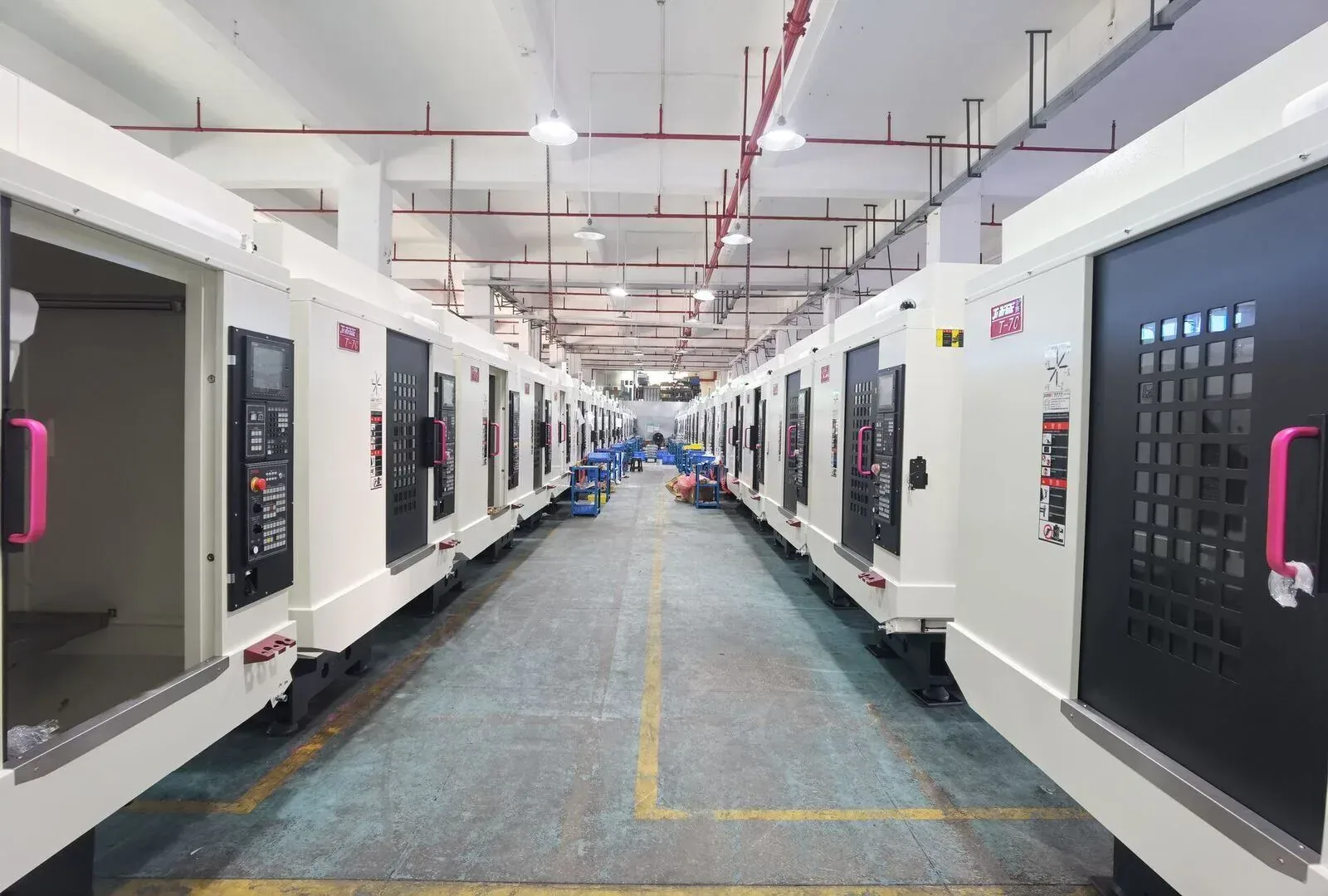
CHX Precision Metal is a precision machining supplier in Shajing, Bao'an District, Shenzhen, founded in 2013. The floor runs 220 CNC machines — 100 five-axis machining centres (30 configured 3+2), 70 Tsugami Swiss-type lathes and 50 CNC lathes — under ISO 9001:2015 and ISO 14001:2015. Standard tolerance is ±0.005 mm, or better where the drawing requires it; prototypes ship in 3–7 working days, production in 7–15, MOQ 1 piece. Capability details: chxmetal.com
Quick answers
Short, self-contained answers to the questions this article is usually asked. Full reasoning is in the sections above.
Which aluminium is best for optical transceiver housings?
6061-T6 for most designs. It machines to ±0.005 mm without drama, anodizes predictably, and its 23.6 ppm/K expansion matches the aluminium parts around it. Choose 7075-T6 only when a thin wall needs to survive handling, and kovar only when the housing is sealed to glass.
Why is kovar used in optical packages?
Because its coefficient of thermal expansion, about 5.1 ppm/K, matches borosilicate glass. That lets a fibre feedthrough or window be sealed through the metal without cracking the glass as the assembly cools. Its poor machinability and high cost mean it is used only where the seal requires it.
Does anodizing change the bore tolerance on a housing?
Yes. A standard 20 µm Type II coating closes a bore by about 20 µm on diameter, which is larger than the whole H7 band on a Ø10 bore. Mask the optical bores, machine them after coating, or specify pre-anodize dimensions with the growth allowance built in.
What surface finish should an optical housing bore have?
Ra 0.8 or better where a lens or ferrule sits, and Ra 1.6 is usually enough on locating faces. Roughness matters more for bonding and for plating adhesion than for the optical path itself, which is set by the component, not by the bore surface.
Related CHX Metal services and notes
- Optical Communication Housing — CHX service page for optical housings.
- CNC Aluminium Parts — Aluminium machining capability and materials.
- Designing for Anodizing: Tolerance and Thread Allowances