Optical Module Housing | Precision Photonics Enclosures
An optical housing is a bore-alignment problem before it is a surface problem: what matters is whether the two bores stay coaxial, not how smooth the outside is. (CHX Metal, Shenzhen) ±0.005 mm on bore position, flatness on the mounting face, 6061 usually, with anodising masked inside so it cannot shift the bore.
CHX Metal (Shenzhen Changhexin Precision Hardware) produces optical module housings (QSFP-DD/CPO) and fiber connector bases with ±0.005mm tolerance for optical communications. ISO 9001:2015 certified. Operations are certified to ISO 9001:2015 and ISO 14001:2015, with CMM inspection on every batch.
Optical Parts
- QSFP-DD / CPO module housings
- Fiber connector bases
- Laser sub-assembly holders
- MT ferrule components
Housings for optical modules are mostly about seats and lids. A laser seat cut a few microns off centre still assembles and still fails on test, which is why seat position gets measured on the CMM instead of trusted to the fixture. Ferrules and connector bases are turned, then checked for burr at the bore.
Precision
- ±0.005mm dimensional
- Tight flatness and position
- Clean deburring
Flatness matters more than the number on the drawing. Thin aluminium lids bow when the vise lets go, so flatness is checked with the part free, on a surface plate, never clamped. Position follows the datum scheme on your print; where the drawing is silent we ask rather than pick one.
Materials
- Aluminum 6061/7075
- Stainless 304
- Copper alloy
6061 for general housings, 7075 when the wall gets thin, 304 where the part is a bracket rather than a housing. Copper alloy turns up for heat spreading and is the one material that dulls tools fastest.
Quality
ISO 9001:2015 certified with dimensional and cosmetic control.
ISO 9001:2015 sets the process. Cosmetic and functional checks are written per part and agreed before the first batch, because a housing can pass every dimension and still fail on a lid that will not sit flat...
Frequently Asked Questions
What optical parts do you make?
QSFP-DD/CPO module housings, fiber connector bases and laser holders, machined to ±0.005 mm with flatness and position control on 5-axis centres.
What tolerance?
±0.005mm dimensional with tight flatness and position control.
Which materials?
Aluminum 6061/7075, stainless 304 and copper alloy.
Do you serve 800G/1.6T modules?
Yes. Housings for 800G and 1.6T modules are machined to ±0.005 mm with flatness and position control on 5-axis centres.
Get a Quote → Upload your drawing/3D model for a process plan and quotation within 24 hours.
Materials & Specifications
We machine optical module housing machining from 6061 aluminum, silver-plated brass, Kovar. Typical accuracy is ±0.005mm, Ra0.8 optical seats. Parts are manufactured to your 2D drawing or 3D model, in sizes from a few millimeters up to 1000mm envelopes, from single prototypes to hundreds of thousands of pieces per year.
Typical Applications
- OSFP/QSFP transceiver housings
- lens barrels and holders
- TEC mounts
- fiber adapter blocks
These are representative examples; we regularly take on custom geometries outside this list. Send your drawing for a feasibility check.
Our Machining Capability
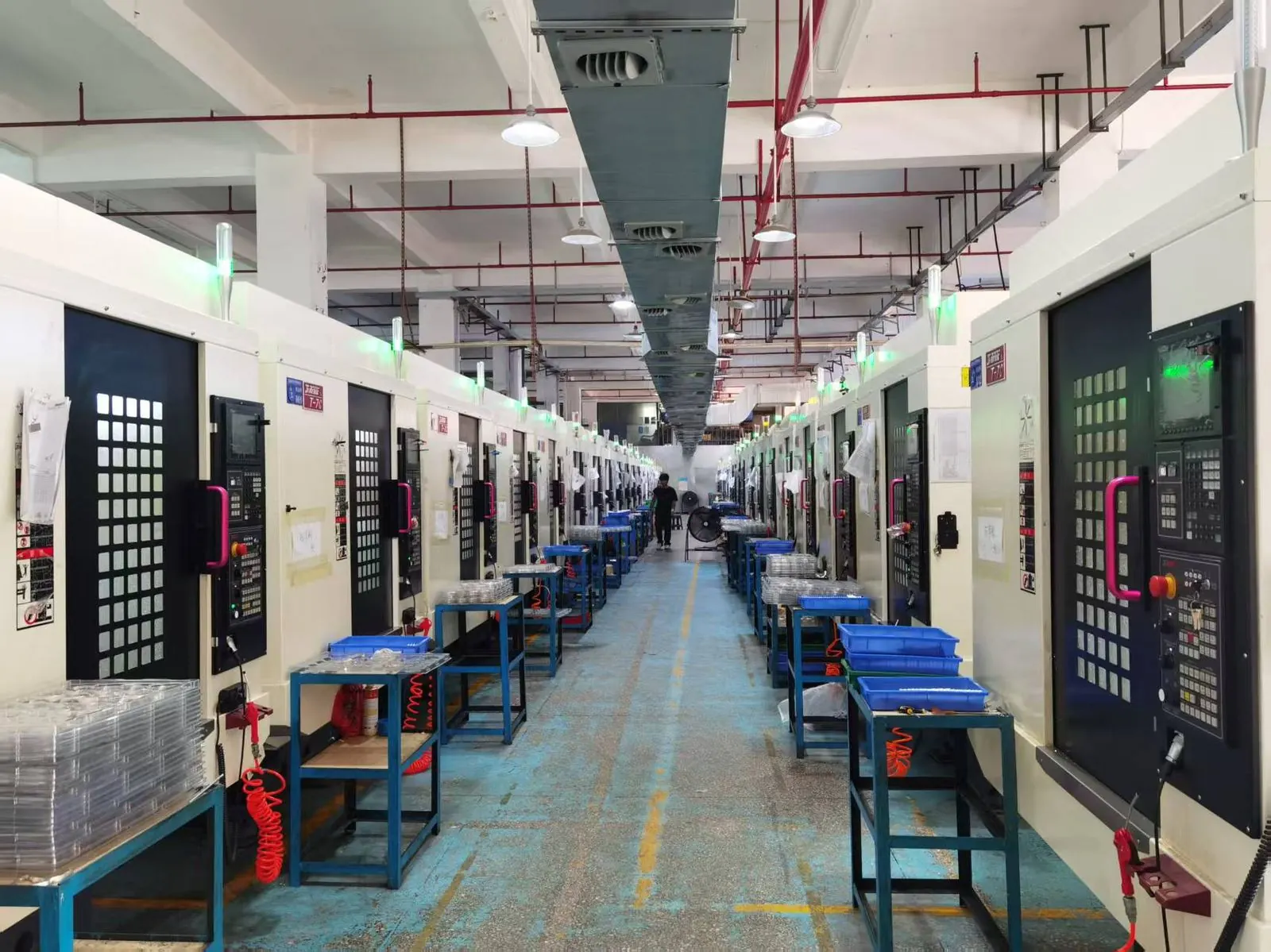
Production runs on 3-axis and 5-axis vertical machining centers, CNC lathes, and Swiss-type automatic lathes. Fixtures are designed in-house for repeatable clamping, and programs are simulated before cutting to protect tight tolerances. Every order ships with in-process inspection records. Our CMM verifies critical dimensions against your drawing on first article, at batch start, and at final release. Material certificates (EN 10204 3.1) and full dimensional reports come standard; PPAP and FAIR documentation are available on request for automotive and industrial programs.
Surface Finishing Options
Available finishes include Type II and Type III anodizing (clear, black, and custom colors), sandblasting, wire drawing, laser engraving and silk-screen marking, zinc and nickel plating, passivation, and black oxide. Cosmetic parts are inspected under standardized lighting with defined surface criteria.
MOQ, Lead Time & Packaging
Standard lead time is 3-7 days for prototypes and 7-15 days for production batches, with surface treatment adding 3-7 days. Parts are cleaned, protected against corrosion and scratching, and packed in customized trays or EPE foam for international shipping. DFM feedback on RFQs is returned within 24 hours.
Why Choose CHX Metal
One supplier from drawing to finished part: milling, turning, 5-axis and Swiss-type machining are all in-house, together with anodizing, plating, laser marking, and silk-screen coordination. You get one accountable partner instead of a chain of subcontractors.
Send your drawing, get a price in 24 hours
Name, email and what you need. Attach a drawing if you have one — STEP, PDF, DXF or a photo of the print. We reply with unit price, MOQ and lead time, usually within one working day.
Prefer email? Send drawings to mc@chxmetal.com.